What is in the bag
- Fine Orchiata Pine Bark 4–8mmLong-lasting structure; slow decomposition under constant humidity30%
- Coco Husk Chips 6–10mmPeat-free replacement for the tree fern fibre in the original ABG recipe25%
- Buffered Coco Coir <3mm screenedReplaces the peat fraction; holds moisture and hosts microfauna20%
- Long-Fibre Sphagnum Moss 1–3cm choppedMoisture reservoir with a naturally acidic, slow-to-rot structure10%
- Horticultural Charcoal 3–6mmRigid pores, adsorption of breakdown compounds, habitat for microbes10%
- Organic Worm Castings <2mmStarter food for springtails and the microbial population5%
| Physical metric | Value | What it means |
|---|---|---|
| Air-filled porosity | 30% | Share of the pot volume holding air after a full watering has drained |
| Water-holding capacity | 48% | Share of the pot volume holding water at container capacity |
| pH range | 5.5–6.2 | Measured in a 1:1.5 water extract after blending |
| Particle grading | 0.5–10mm | Screened range of the structural fraction |
| Starting EC | 0.2–0.4 mS/cm | Low enough for tissue-culture and freshly cleaned roots |
Who it is for: root morphology
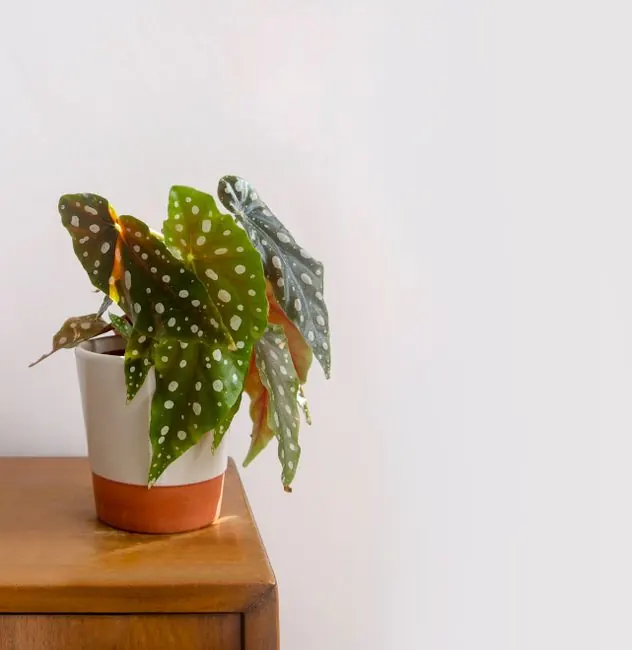
Most terrarium plants are small forest-floor or bank-dwelling species: miniature Begonia from Borneo and Sarawak, jewel orchids such as Ludisia and Macodes, Selaginella, small ferns and creeping figs. Their roots are fine and shallow, often running through only the top 3–5cm of leaf litter and moss, and many root at every node as they creep. In a closed tank at 85–100% relative humidity, transpiration is minimal, so these roots take up water slowly and depend heavily on air in the substrate rather than on drying cycles to stay healthy.
In a bioactive vivarium the roots also share the substrate with springtails, isopods and a dense microbial population that break down leaf litter and frog or gecko waste. A good substrate is habitat for that cleanup crew as much as it is a rooting medium.
Plants this blend suits: Begonia amphioxus, Begonia darthvaderiana, Begonia 'Black Mamba', Begonia prismatocarpa, Ludisia discolor, Macodes petola, Fittonia albivenis, Selaginella kraussiana, Peperomia prostrata, Pilea glauca, Ficus pumila 'Quercifolia', Hemionitis arifolia, Marcgravia sp., Pellionia repens, Cryptanthus, small Neoregelia.
Why this formulation works
The original ABG mix was developed at the Atlanta Botanical Garden for tropical frog enclosures: tree fern fibre, sphagnum, charcoal, peat and orchid bark in roughly 2:1:1:2:2 proportions. Its genius was that it resisted the compaction and souring that ruin ordinary potting compost in a permanently wet, closed environment. Our version keeps the logic and removes the two ingredients we will not use. Peat is replaced with buffered coco coir, and tree fern fibre, slow-growing and restricted in trade, is replaced with coco husk chips, which give the same internal water storage and rigid, non-collapsing structure.
Under glass, decomposition rate is everything. In a closed terrarium the substrate never dries, so microbial activity runs constantly, and a mix with a lot of fine, easily digested organic matter slumps within months. As it slumps, AFP drops, the lower layers go anaerobic and the tank starts to smell of sulphur. That is why 55% of this blend is bark and husk chips, both lignin-rich and slow to break down, and why charcoal makes up 10%. The finished AFP of 30% is well above what you would choose for an open-room Calathea mix of similar moisture, because in a closed tank there is no evaporation to pull air back into the substrate after watering.
Water in a terrarium must go somewhere, so this substrate is designed to sit on a drainage layer: 3–5cm of LECA or lava rock topped with fine mesh, which keeps the base of the substrate above the standing water. The coir and sphagnum fractions wick moisture upwards from that layer and hold it in the root zone without flooding it. Sphagnum's naturally low pH and its slow, rot-resistant fibres help keep the upper layer from going mouldy in the first few weeks, while the mould that does appear on new hardscape is grazed down quickly once springtails are established.
Nutrients are kept deliberately low, with an EC of 0.2–0.4 mS/cm. In a closed tank, a rich substrate drives soft, leggy growth that quickly outgrows the glass, and excess nutrients feed algae on the front pane. The 5% of worm castings is there mainly to feed the springtail and microbial populations through the first months, until leaf litter and animal waste take over that role. For a typical 30 x 30 x 45cm tank you will need around 5L of substrate for a 6–8cm layer over the drainage layer.
When and how to repot
- Clean the glass and hardscape. Add a 3–5cm drainage layer of LECA or lava rock and cover it with a fine mesh barrier cut to the size of the base.
- Rehydrate the substrate in a bucket with dechlorinated or rainwater until a squeezed handful releases only a few drops. Never add it dry, or it will float and channel water.
- Spread the substrate over the mesh in a 6–8cm layer, deeper at the back than the front to create a slope and give rooting depth for larger plants.
- Set hardscape such as cork bark and wood first, pressing it into the substrate so it does not shift later.
- Remove each plant from its pot, gently tease off as much of the old compost as possible, and plant at the same depth, firming the substrate lightly around the roots.
- Top-dress with a thin layer of sphagnum and dried oak or magnolia leaf litter, then introduce springtails and, for bioactive setups, isopods.
- Mist lightly, close the lid and observe for two to three weeks. Condensation should clear from the glass for part of each day; if it never clears, vent the lid slightly until it does.
Open the repotting calculator pre-set for Terrarium & Vivarium Mix to work out litres, bag sizes and pot sizes for your whole collection.