- Semi-hydro grows plants in inert mineral media that wick water up from a reservoir at the base of the pot.
- Soil roots partly die back after transfer and the plant grows new water-adapted roots over three to eight weeks.
- LECA holds no nutrients, so every feed must supply a complete solution; aim for EC 0.6–1.0 mS/cm and pH 5.5–6.5 once established.
- Hard tap water raises pH; soft water lacks calcium and magnesium. Adjust for your region.
- Flush the pot with plain water every two to four weeks to remove salt build-up.
What semi-hydro is and why growers switch
Semi-hydroponics, or passive hydroponics, grows plants in a pot of inert mineral particles standing over a small reservoir of nutrient solution. The medium wicks solution upward by capillary action while the spaces between particles stay full of air. Roots get water and oxygen at the same time without the grower having to judge when to water.
Growers switch for three main reasons. There is no organic matter to break down, compact or go sour, so the structure of the root zone never changes. Fungus gnats have nothing to feed on. And with the reservoir visible through a clear pot, watering becomes a matter of topping up when the level drops rather than reading the substrate. Alocasia, Anthurium, climbing Philodendron, Monstera, Hoya and Epipremnum all grow well in it once transitioned.
The trade-off is that the grower takes full control of nutrition. A mineral medium supplies nothing; everything the plant needs must arrive in the water.
Choosing the medium: LECA, pon, pumice and zeolite
LECA, or lightweight expanded clay aggregate, is clay fired into round, porous balls, typically 4–16mm. It is clean, reusable and close to pH neutral once rinsed. Its wicking height is limited, a few centimetres above the reservoir, so the top of a tall pot of LECA stays dry. It holds no nutrients at all.
Pon is a blend of mineral particles, usually pumice, zeolite and lava rock, sometimes sold with a slow-release fertiliser added. Its finer, irregular particles wick higher and more evenly than LECA, and the zeolite component carries a high cation exchange capacity, holding and releasing potassium, ammonium and calcium. That makes pon more forgiving of feeding mistakes. Pumice alone wicks well and holds water inside its pores; zeolite alone is too heavy and fine for most pots but valuable as a component.
Our Mineral Semi-Hydro Substrate combines pumice, zeolite, lava rock and LECA so the wicking of pon and the open structure of LECA work together. Rinse any mineral medium thoroughly before use to remove dust, which clogs pores and clouds the reservoir, and soak LECA for 24 hours so it starts fully hydrated.
Water-root induction: what happens after transfer
Roots grown in an organic substrate developed for a cycle of wetting and drying in a medium that holds air in a particular way. Moved into a permanently moist mineral medium, many of those roots cannot adapt. Over the first two to four weeks some of them soften, brown and die back; this is expected and is not the same as rot spreading through the plant.
Meanwhile the plant grows new roots adapted to constant moisture. These water roots are often smoother, whiter and more brittle, with more internal air channels that carry oxygen down from the stem. New roots usually appear within three to eight weeks, depending on genus, temperature and light. Until they do, the plant is drawing on reserves and may lose an older leaf or two.
Timing and conditions decide success. Transition in active growth, between April and September, at 20–26°C and in good light. A plant in winter dormancy, or one already struggling, has too little energy to replace its roots. Some growers root cuttings in water first and move them straight into semi-hydro, which skips the die-back stage entirely, because water-grown roots already suit the conditions.
The transfer itself
Every trace of organic substrate must come off. Bark, coir and compost left among the roots will rot in the constant moisture and take healthy roots with them. Soak the root ball in tepid water, work it loose, rinse under a gentle tap and pick off remaining fragments. Trim dead or damaged roots with a sterilised blade.
Use a clear pot with holes in the side about a quarter to a third of the way up, rather than in the base, so the bottom forms a reservoir; or stand a standard pot inside a cachepot that holds solution to that depth. Set the plant at its original depth with the roots spread, fill around them with pre-soaked medium and tap to settle. Keep the crown and stem base well above the reservoir. Fill the reservoir with plain water or very dilute solution for the first fortnight while the plant begins replacing roots, and raise humidity around the leaves.
Nutrients, EC and pH
Use a complete hydroponic nutrient containing calcium, magnesium and trace elements, not a standard houseplant fertiliser designed for soil, which assumes the substrate supplies some of those. Measure strength with an inexpensive EC pen. EC, or electrical conductivity, reads the total dissolved salts in the solution in mS/cm.
- During transition: EC 0.3–0.5 mS/cm, or plain water for the first two weeks.
- Established aroids: EC 0.6–1.0 mS/cm; vigorous Monstera and Philodendron in bright light can take up to 1.2.
- pH: 5.5–6.5, the range in which iron, manganese and phosphorus stay available.
Your tap water changes the picture. Measure its EC before adding feed: very hard water from chalk and limestone aquifers, as in London, Bristol and Bath, can read 0.5–0.7 mS/cm on its own, mostly calcium bicarbonate, which also pushes pH up to 7.5 or beyond and causes iron deficiency in new leaves. Lower the pH with a hydroponic pH-down product, or blend tap water with rainwater or reverse-osmosis water. Very soft water, as in Glasgow and Manchester, reads close to zero and carries little calcium or magnesium; make sure your nutrient supplies both, or add a calcium-magnesium supplement. Our regional delivery pages list typical hardness by area.
Reservoir management and flushing
Keep the reservoir level at or below the side holes and let it fall almost to empty before refilling; a day or two with a low reservoir draws fresh air down through the medium. Top up with solution at your target EC. Do not keep topping a full reservoir, which leaves the lower roots permanently submerged.
Salts accumulate as water evaporates and the plant takes up some nutrients faster than others. A white crust on the top particles is the visible sign; rising EC in the runoff is the measurable one. Every two to four weeks, flush the pot by running three to four pot volumes of plain or low-EC water through it, then refill with fresh solution. Clean the pot and rinse the medium thoroughly whenever you repot. Algae in the reservoir is common in clear pots and mostly cosmetic; an opaque cachepot prevents it.
Watch the solution temperature as well. Water holds less dissolved oxygen as it warms, so a reservoir sitting at 28°C on a sunny summer windowsill gives roots less oxygen than one at 20°C, and warm, stagnant solution favours root pathogens. Shade the pot in hot spells and refresh the reservoir more often. In winter the opposite applies: a pot on a cold sill can chill the solution below 15°C, slowing uptake, so move semi-hydro plants away from the glass on cold nights.
Alocasia in semi-hydro
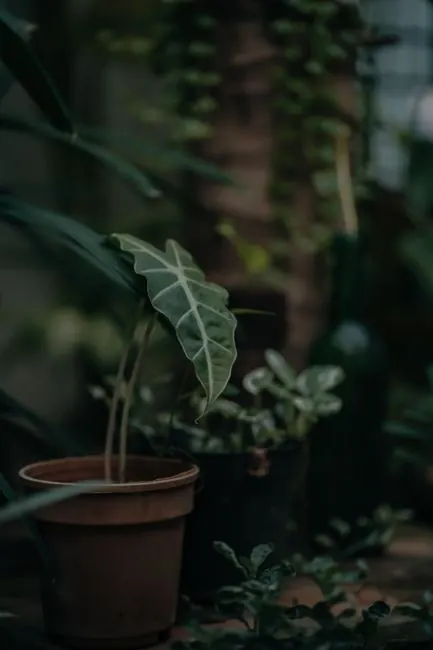
Alocasia is one of the genera that benefits most. Its fine roots want steady moisture without compaction, which is exactly what semi-hydro provides, and the clear pot shows the roots through growth and dormancy. Transition only a plant in active growth with at least three healthy leaves. If it drops leaves during the switch, check the corm: a firm corm will regrow. Keep a close eye on leaf undersides, because spider mites like Alocasia whatever it grows in. In autumn, lower the reservoir and the feed as growth slows rather than keeping summer levels into a dim winter.
Step-by-step protocol
- Choose a plant in active growthTransition between April and September, selecting a healthy plant with several leaves and no signs of rot.
- Prepare the mediumRinse the mineral medium until the water runs clear and soak LECA for 24 hours.
- Remove all organic substrateSoak and rinse the root ball until no bark, coir or compost remains, then trim dead roots with a sterilised blade.
- Set up a reservoir potUse a clear pot with side holes a quarter to a third of the way up, or a standard pot standing in a cachepot.
- Pot at the original depthFill around the spread roots with the soaked medium, keeping the crown well above the reservoir level.
- Start with plain waterFill the reservoir with plain water or a solution at EC 0.3–0.5 for the first two weeks and raise humidity around the leaves.
- Expect root die-backAllow some soil roots to soften and die over two to four weeks while new water roots form.
- Raise feed once new roots appearIncrease to EC 0.6–1.0 mS/cm at pH 5.5–6.5 once new white roots are visible in the medium.
- Flush every two to four weeksRun three to four pot volumes of plain water through the pot, then refill with fresh solution.
Symptoms vs root causes
| Symptom | Root cause | Action |
|---|---|---|
| Old roots turning soft and brown in the first weeks | Normal die-back of soil-adapted roots | Keep the reservoir low and wait for new water roots. |
| Stem base softening | Organic substrate left on roots or crown sitting too low | Unpot, clean the roots fully and reset with the crown higher. |
| Yellow new leaves with green veins | High pH from hard tap water locking out iron | Lower pH to 5.5–6.5 or blend with rainwater or RO water. |
| White crust on the top particles | Salt and mineral build-up from evaporation | Flush with three to four pot volumes of plain water. |
| Brown leaf tips on an established plant | EC too high | Flush and reduce the feed strength by a third. |
| No new roots after eight weeks | Too cool, too dark or transitioned in dormancy | Move to 20–26°C and brighter light, or wait for spring. |