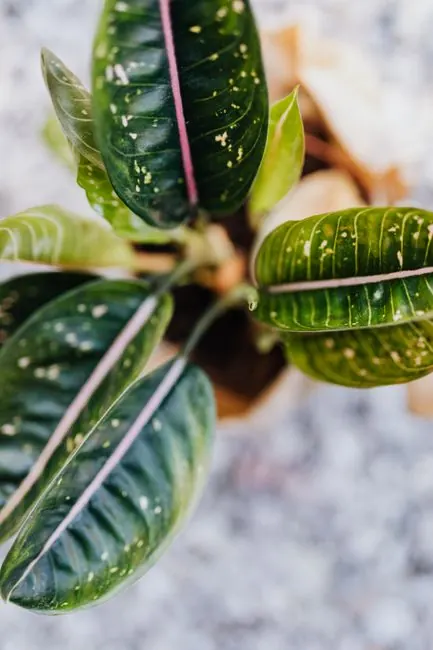
Botanical overview & native habitat
Aglaonema, the Chinese evergreens, are about 22 species from the forest floors of tropical and subtropical Asia, from southern China and the Philippines to New Guinea. Aglaonema pictum grows in the wet forests of Sumatra, where its camouflage-patterned leaves blend into dappled shade. Dieffenbachia, around 56 species, fills the same niche in Central and South America. Both grow on upright, cane-like stems in humid, deeply shaded understorey where light rarely exceeds a few percent of full sun.
That low-light adaptation is why these plants are the backbone of residential and office schemes. Green and silver Aglaonema such as 'Silver Bay' and A. commutatum 'Maria' keep growing at 25–75 µmol/m²/s, which is around 2–3m back from a north window. Pink and red hybrids such as 'Red Star' need more, around 100–150 µmol/m²/s, to hold colour. Standard office lighting of 500 lux supplies less than 10 µmol/m²/s, so office plants should still sit within reach of a window or have an LED over them.
The real weakness is cold. Aglaonema suffers chilling injury below about 13°C: grey, water-soaked patches appear on leaves days after a cold draught or a chilly delivery van. Keep them away from opening doors and single glazing in winter. Our Winter Thermal Guard ships them with a heat pack when temperatures drop below 5°C.
Aglaonema pictum 'Tricolor' is the collector exception: slow, humidity-loving and best in 65% humidity or more. Dieffenbachia grows taller and faster, and its sap is a strong irritant, so wear gloves when pruning. Both grow well in Simply Houseplant Everyday Mix, which holds enough moisture for a low-light plant without staying wet.
These plants grow slowly, producing perhaps four to six leaves a year in a typical room, so they rarely need repotting more than every two years. Feed at half strength monthly from April to September only. Divide crowded Aglaonema clumps in spring by separating stems with their own roots; Dieffenbachia canes can be cut into 5cm sections and laid on damp mix to sprout. In offices, a fortnightly moisture check through a clear inner pot prevents the most common failure: several people each watering the same plant.
Varieties we grow and acclimatise
| Variety | Notes | From |
|---|---|---|
| Aglaonema pictum 'Tricolor' | Camouflage patches of green, silver and olive from Sumatra. Slow; wants 65%+ humidity. | £18.00 |
| Aglaonema 'Silver Bay' | Large silver-centred leaves on a dense clump. The toughest low-light choice. | £7.99 |
| Aglaonema 'Red Star' | Red-flushed leaves with green edges. Needs brighter light to hold colour. | £8.99 |
| Aglaonema commutatum 'Maria' | Dark green with silver feathering. Tolerates the dimmest corners. | £6.99 |
| Aglaonema 'Stripes' | Long, narrow leaves with silver herringbone stripes. Compact desk plant. | £7.99 |
| Dieffenbachia seguine 'Tropic Snow' | Large cream-centred leaves on a cane. Fast and upright. | £8.99 |
| Dieffenbachia 'Camille' | Creamy yellow leaves with a green margin. Compact and bushy. | £6.99 |
Growth stages & pricing
| Stage | Price range |
|---|---|
| In-vitro tissue culture cup | £8.99 – £19.99 |
| 6cm baby plant | £4.99 – £18.00 |
| 12cm established plant | £18.00 – £38.00 |
| 15cm+ collector specimen | £60.00 – £120.00 |
Substrate & pot
We pot every Aglaonema & Dieffenbachia in our Everyday Peat-Free Houseplant Base Mix (AFP 24%). Clear slotted pot inside a glazed cachepot; step up only every two years.
- Buffered Coco Coir <3mm screenedMoisture retention and an easy-to-rewet base30%
- Fine Orchiata Pine Bark 4–8mmStructure and air at root scale; slow to break down25%
- Coarse Perlite 3–6mmPermanent air space; stops the coir compacting20%
- Coco Husk Chips 6–10mmStored water with open channels between chips10%
- Organic Worm Castings <2mmSteady nutrition and microbial life10%
- Horticultural Charcoal 3–6mmRigid pores that keep the mix fresh over time5%
Troubleshooting
| Symptom | Likely cause | What to do |
|---|---|---|
| Grey, water-soaked patches on leaves | Chilling injury below about 13°C | Move away from cold glass and draughts; trim damaged leaves once new growth appears. |
| Red or pink cultivars turning green | Light too low for pigment | Move to 100–150 µmol/m²/s or add a small LED. |
| Lower leaves yellowing one by one | Natural ageing, or overwatering if fast | Normal at one leaf every few months; if quicker, let the mix dry further between waterings. |
| Bare cane with leaves only at the top | Age and low light | Cut the cane to 10cm; it resprouts from below, and the top can be rooted. |
| Cottony white patches in leaf bases | Mealybugs | Dab with isopropyl alcohol weekly for a month and isolate the plant. |