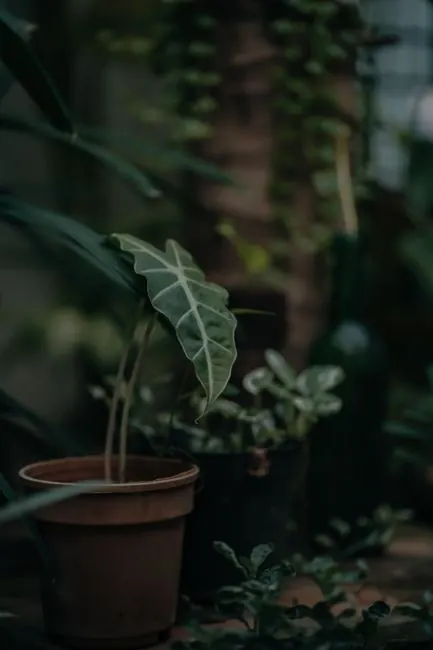
Botanical overview & native habitat
Alocasia includes roughly 90 species from tropical and subtropical Asia to eastern Australia, with the richest diversity in Borneo, the Philippines and New Guinea. The jewel species collectors grow, such as Alocasia cuprea, A. baginda ('Dragon Scale' and 'Silver Dragon') and A. reginula ('Black Velvet'), grow terrestrially on steep, well-drained slopes, often over limestone, rooted into a thin layer of leaf litter over rock. Alocasia micholitziana 'Frydek' and A. zebrina come from the Philippines; 'Jacklyn' is a recently described species from Sulawesi.
Water runs through their root zone quickly, and the plants store reserves in an upright rhizome, often called a corm, that lets them sit out dry or cool spells.
Alocasias hold three to five leaves at a time; losing the oldest as a new one opens is normal. What alarms UK growers is dormancy. Below about 15°C, or when winter light falls under 3 mol/m²/day, many plants shed every leaf. The corm is still alive: check it is firm, keep the pot somewhere around 18°C, water only enough to stop the mix going bone dry, and wait for new growth in March or April. Throwing away a leafless pot is the most common way an Alocasia is lost.
Every repot is a chance to harvest offsets. Small corms, often the size of a pea, form among the roots. Peel back the brown outer husk without cutting the white tissue, set them half-buried in damp sphagnum or fine perlite in a lidded box at 22–25°C, and most sprout in three to eight weeks.
The roots rot in anything dense, so our plants grow in Alocasia Corm & Tuber Mix, which drains in seconds and holds moisture in pumice rather than fibre. Spider mites are the main pest in dry centrally heated rooms; check leaf undersides weekly and release predatory mites at the first fine webbing.
Light drives leaf size. At 200–350 µmol/m²/s each new leaf is usually larger than the last; below 100 the plant produces small, long-stalked leaves and is more likely to go dormant in autumn. Keep the pot snug, since an oversized pot stays wet around a small root system, and repot in late spring when growth is strongest, never in winter.
Varieties we grow and acclimatise
| Variety | Notes | From |
|---|---|---|
| Alocasia micholitziana 'Frydek Variegata' | Velvet arrowheads with white sectors on a chimera. Needs steady warmth above 18°C. | £16.99 |
| Alocasia 'Jacklyn' | Deeply lobed leaves with dark vein patterning. One of the faster jewel species once settled. | £12.99 |
| Alocasia baginda 'Dragon Scale' | Thick, textured silver-green leaves like reptile skin. Compact and pot-happy. | £9.99 |
| Alocasia baginda 'Silver Dragon' | Pale silver leaves with dark veins. Slightly more sensitive to wet roots than Dragon Scale. | £12.99 |
| Alocasia cuprea | Metallic copper-red leaves from Borneo. Wants 70% humidity and a well-drained mix. | £14.99 |
| Alocasia zebrina | Zebra-striped petioles under plain arrow leaves. Tall and quick; stake as it passes 60cm. | £7.99 |
| Alocasia reginula 'Black Velvet' | Near-black velvet leaves with silver veins. Small, slow and ideal for a shelf. | £9.99 |
Growth stages & pricing
| Stage | Price range |
|---|---|
| In-vitro tissue culture cup | £9.99 – £24.99 |
| 6cm baby plant | £5.99 – £16.99 |
| 12cm established plant | £18.00 – £45.00 |
| 15cm+ collector specimen | £60.00 – £160.00 |
Substrate & pot
We pot every Alocasia in our Alocasia & Corm Moisture-Balanced Mix (AFP 26%). Clear slotted pot sized snugly to the roots; step up only when roots circle the base.
- Fine Orchiata Pine Bark 4–8mmOpen structure at a scale that fine roots can colonise25%
- Buffered Coco Coir <3mm screenedEven moisture film; calcium-buffered so it does not strip calcium and magnesium25%
- Coco Husk Chips 6–10mmInternal water storage with air between chips15%
- Coarse Perlite 3–6mmKeeps the coir fraction from collapsing into a dense block15%
- Vermiculite 2–4mmHolds water and potassium in its layered plates; high CEC10%
- Volcanic Pumice 3–6mmWeight and permanent porosity at the base of the root ball5%
- Organic Worm Castings <2mmMicrobial inoculum and gentle background nutrition5%
Troubleshooting
| Symptom | Likely cause | What to do |
|---|---|---|
| All leaves dropped in autumn or winter | Dormancy triggered by cold or low light | Check the corm is firm, keep it near 18°C, water sparingly and wait for spring growth. |
| Fine webbing and pale speckles under leaves | Spider mites in dry, warm air | Rinse leaf undersides, raise humidity and release predatory mites such as Phytoseiulus persimilis. |
| Drops of water at leaf tips in the morning | Guttation from a well-watered plant | Normal. Wipe off the drops; reduce watering slightly if it happens every day in winter. |
| Corm soft and smelling sour | Rot from a wet, dense mix | Cut back to firm white tissue, dry the cut for a day, then set on damp perlite in a warm box. |
| New leaf smaller than the last | Root disturbance, low light or an oversized pot | Keep the pot snug, give 200+ µmol/m²/s and avoid repotting more than once a year. |