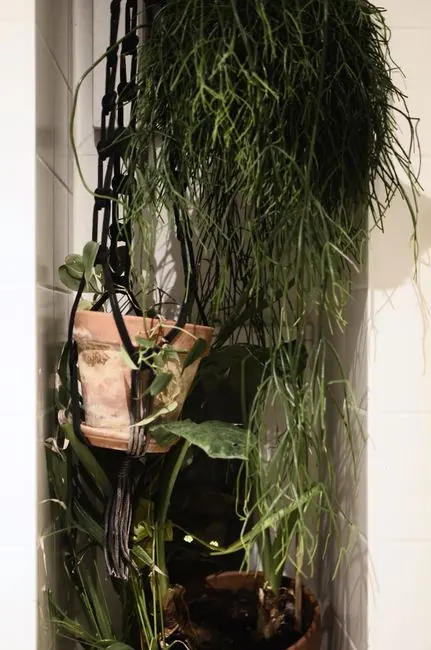
Botanical overview & native habitat
Not every cactus lives in a desert. Rhipsalis, with around 35 species, grows as an epiphyte in the canopy of tropical forest from Mexico to Argentina, with its centre of diversity in Brazil's Atlantic forest. Rhipsalis baccifera is the only cactus native outside the Americas, found wild in tropical Africa, Madagascar and Sri Lanka, probably spread by birds eating its berries. Related jungle cacti include Lepismium, Hatiora, Epiphyllum and Schlumbergera, the Christmas cactus. They root into moss, bark and leaf litter in tree forks, in humid, filtered light.
Treat them as forest plants, not desert plants. Rhipsalis burns in unfiltered south-facing summer sun but thrives 1–2m from an east or west window at 100–300 µmol/m²/s, or in a hanging basket in a bright bathroom. Water when the mix is nearly dry, roughly every 7–10 days in summer, and expect long trailing stems to reach 1–2m over a few years.
Flowering depends on a winter rest. From November to January, give six to eight weeks at 12–15°C with water cut to once every three or four weeks and no feed. Long, cool nights trigger buds on most species; Schlumbergera and Hatiora need 12 hours or more of darkness, so keep them away from rooms lit in the evening. Small white or cream flowers, followed by berries, form along the stems in late winter and spring. Once buds form, do not move the plant, as bud drop follows sudden changes.
The roots are fine and need air, so we grow these plants in Hoya Epiphytic Bark Mix, the same fast-draining bark and pumice blend as our hoyas, rather than a gritty desert cactus mix that holds too little moisture. Segments root easily: let a cutting dry for a day, then lay it on damp mix.
Hanging baskets suit them best, letting stems drop freely and air move around the root zone. Feed monthly at half strength from April to September with a balanced or slightly potassium-rich fertiliser, and stop during the rest. Repot only every two or three years, as the fine roots dislike disturbance and plants flower more freely when snug. Mealybugs are the main pest; check stem joints and treat early.
Varieties we grow and acclimatise
| Variety | Notes | From |
|---|---|---|
| Rhipsalis baccifera | Fine, pencil-thin trailing stems and white berries. The mistletoe cactus. | £5.99 |
| Rhipsalis paradoxa | Chain-link stems of alternating triangular segments. Striking in a basket. | £7.99 |
| Rhipsalis pilocarpa | Fuzzy stems and scented white flowers in late winter. | £8.99 |
| Rhipsalis cereuscula | The coral cactus: short whorled branches at stem tips. Compact and quick. | £5.99 |
| Lepismium cruciforme | Angular stems that turn purple-red in bright light. Pink flowers. | £7.99 |
| Hatiora salicornioides | Dancing bones cactus: bottle-shaped segments and yellow flowers. | £6.99 |
| Epiphyllum anguliger | The fishbone cactus: flat, zigzag stems and fragrant night flowers. | £6.99 |
Growth stages & pricing
| Stage | Price range |
|---|---|
| Rooted cutting plug (5cm) | £4.99 – £8.99 |
| 6cm baby plant | £5.99 – £12.99 |
| 12cm established plant | £18.00 – £30.00 |
| 15cm+ hanging specimen | £60.00 – £95.00 |
Substrate & pot
We pot every Rhipsalis & Epiphytic Cacti in our Hoya & Epiphytic Vine Fast-Drain Mix (AFP 42%). Hanging basket or small clear pot; keep snug and repot every 2–3 years.
- Orchiata Pine Bark 6–12mmOpen structure scaled for small pots and fine roots35%
- Volcanic Pumice 4–8mmPermanent porosity and weight; wicks a little moisture through the pot25%
- Coco Husk Chips 6–10mmWater held within the chip, released slowly20%
- Horticultural Charcoal 4–8mmRigid air spaces; keeps the mix sweet in small, slow-drying pots10%
- Coarse Perlite 3–6mmLight air space at the surface5%
- Organic Worm Castings <2mmGentle nitrogen and microbial life5%
Troubleshooting
| Symptom | Likely cause | What to do |
|---|---|---|
| Stems turning yellow or red and shrivelled | Too much direct sun | Move back from the window or behind a net curtain. |
| No flowers | No cool, dry winter rest or lit evenings | Give 6–8 weeks at 12–15°C with little water and long dark nights. |
| Buds drop before opening | Moving the plant or a temperature swing | Leave the plant in place once buds form; water steadily. |
| Stems soft and black at the base | Root rot from wet, dense compost | Take healthy cuttings, dry them for a day and restart in bark mix. |
| Stems shedding segments | Drought stress or root damage | Water more regularly in growth and check roots; root fallen segments. |