What is in the bag
- Orchiata Pine Bark 6–12mmOpen structure scaled for small pots and fine roots35%
- Volcanic Pumice 4–8mmPermanent porosity and weight; wicks a little moisture through the pot25%
- Coco Husk Chips 6–10mmWater held within the chip, released slowly20%
- Horticultural Charcoal 4–8mmRigid air spaces; keeps the mix sweet in small, slow-drying pots10%
- Coarse Perlite 3–6mmLight air space at the surface5%
- Organic Worm Castings <2mmGentle nitrogen and microbial life5%
| Physical metric | Value | What it means |
|---|---|---|
| Air-filled porosity | 42% | Share of the pot volume holding air after a full watering has drained |
| Water-holding capacity | 33% | Share of the pot volume holding water at container capacity |
| pH range | 5.8–6.4 | Measured in a 1:1.5 water extract after blending |
| Particle grading | 2–12mm | Screened range of the structural fraction |
| Starting EC | 0.3–0.6 mS/cm | Low enough for tissue-culture and freshly cleaned roots |
Who it is for: root morphology
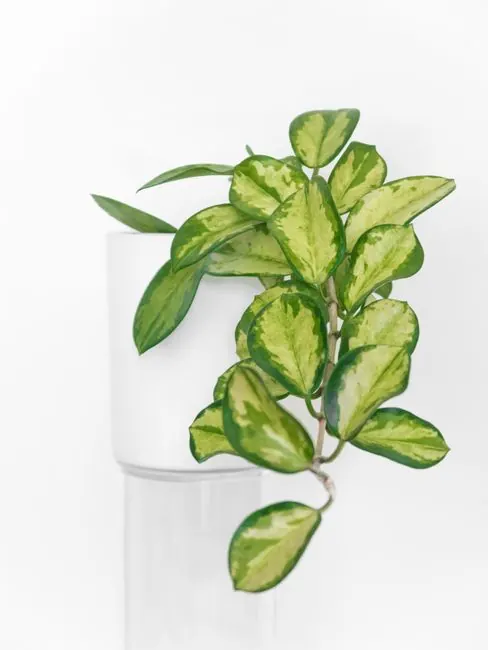
Hoya roots are fine, wiry and pale, usually under 1–2mm thick, and they branch sparingly. In South East Asian and Australasian forests most species grow as epiphytes, rooting into thin pockets of bark and moss on branches, or scramble over rocks. A single Hoya stem can sustain a metre of vine from a remarkably small root system, which is why these plants are traditionally kept in small pots for years.
Because the root mass is small relative to the volume of a pot, a Hoya in an oversized container is surrounded by wet substrate its roots cannot reach or use. That substrate stays damp, sours and rots the roots it does touch. Thin-leaved species such as Hoya linearis and Hoya 'Mathilde' have the finest roots of all and are least forgiving; thick-leaved succulent types such as Hoya kerrii and Hoya obovata store water in their leaves and tolerate longer dry spells.
Plants this blend suits: Hoya carnosa 'Compacta', Hoya carnosa 'Krimson Queen', Hoya kerrii, Hoya linearis, Hoya 'Mathilde', Hoya callistophylla, Hoya latifolia, Hoya obovata, Hoya pubicalyx, Hoya australis, Dischidia nummularia, Dischidia ovata, Scindapsus pictus, Rhipsalis baccifera, Peperomia prostrata.
Why this formulation works
The two numbers that define this blend are 42% AFP and 33% WHC. A Hoya mix must drain almost as fast as an Anthurium mix, but in a much smaller pot. That is harder than it sounds, because the perched water table in a container is roughly constant in height for a given particle size: in a 9cm pot, a 2cm saturated layer is a far bigger share of the volume than in a 20cm pot. We counter that with 6–12mm bark and 4–8mm pumice, which keep the saturated layer shallow, and a WHC low enough that a 9cm pot dries back in five to seven days on a bright summer windowsill.
The mix is lighter in organic matter than our aroid blends. Pumice makes up a quarter of the volume because it is permanent and slightly wicking; it pulls moisture upwards through the pot by capillarity, so the fine roots in the middle of the root ball get a steady trickle of water rather than alternating flood and drought. Coco husk chips provide the stored water, and charcoal at 10% gives rigid, non-collapsing air spaces. Hoya is often left in the same pot for two or three years, so slow decomposition matters far more here than in a fast-growing aroid that is repotted every season.
Nutritionally we keep the start gentle: 5% worm castings and an EC of 0.3–0.6 mS/cm. Hoya flower on peduncles, short spurs that re-flower year after year, and plants pushed hard with nitrogen tend to put out long, leafless vining stems instead of buds. A low-nitrogen, higher-potassium feed at half strength from April to September, combined with bright light (above 200 µmol/m²/s for a few hours a day) and a slightly root-bound pot, gives the best flowering. Never cut off old peduncles; next year's umbels form on them.
In a British home, Hoya are among the best plants for a sunny, centrally heated room, provided the roots dry back properly. The usual failure we see is in winter, when light falls below 3 mol/m²/day, the plant all but stops drinking, and it sits in damp substrate at 18°C. In this mix, water every two to four weeks from November to February, and only when the pot is completely dry and noticeably lighter. Fungus gnats rarely establish in a surface this coarse and dry, which makes it a good choice for kitchens and bedrooms.
When and how to repot
- Only repot when roots fill the pot densely, grow out of the drainage holes, or the mix has visibly broken down. Most Hoyas need repotting every two to three years.
- Lightly moisten the mix so the husk chips are damp. Do not soak it; Hoyas are best settled into a mix that is barely moist.
- Let the plant dry out for a few days before repotting so the roots are flexible and the old mix crumbles away more easily.
- Tease out the root ball over a tray, removing as much old, broken-down substrate as possible without stripping the fine roots. Trim any that are brown, soft or hollow.
- Step up by no more than 1–2cm in diameter. A 9cm Hoya usually goes into a 10–11cm pot, never straight into a 15cm one.
- Set the plant at its previous depth, add mix around the roots and tap the pot firmly to settle it. Re-attach any vines to a trellis or hoop.
- Water lightly once, let it drain, then wait until the mix is dry before watering again. Do not move the plant if it has buds, as Hoyas often drop buds after a change of position.
Open the repotting calculator pre-set for Hoya & Epiphyte Mix to work out litres, bag sizes and pot sizes for your whole collection.