- Air-filled porosity (AFP) is the share of pot volume holding air after drainage; aroids need roughly 25–44%.
- Fine green-waste and wood-fibre composts often settle below 8% AFP within months, suffocating epiphytic roots.
- Cation exchange capacity (CEC) is the substrate's ability to hold and release nutrients; coir, worm castings and zeolite supply it, perlite and pumice do not.
- The UK government has committed to ending peat sales in amateur horticulture in England, starting with retail bagged compost.
- You can measure AFP at home with a pot, a jug and a measuring cylinder.
Why substrate structure matters more than the watering schedule
Most houseplant advice is about how often to water. The more useful question is what happens to that water once it is in the pot. A root needs water and oxygen at the same time, from the same few millimetres of substrate. Oxygen diffuses roughly ten thousand times more slowly through water than through air, so a root sitting in a water-filled pore is effectively holding its breath. The structure of the substrate decides how much of the pot is air and how much is water once drainage stops, and that balance is fixed by the particles themselves, not by the grower's routine.
That is why the same watering habit can suit one mix and kill a plant in another. Change the substrate and you change the ratio of air to water in every pore, every time you water.
Pore space: total porosity, AFP and water-holding capacity
A potting substrate is mostly empty space. Total porosity, usually 60–85% of the volume, is the share not occupied by solid particles. After a thorough watering and free drainage, that space divides into two parts. Water-holding capacity (WHC) is the share still holding water, held by capillary forces in the small pores. Air-filled porosity (AFP) is the share holding air, in the large pores that gravity has emptied.
Large particles create large pores. Fine particles create small pores that hold water against gravity. A substrate built from 5–18mm bark, husk chips and pumice drains to a high AFP; a substrate of sub-millimetre fibres drains to almost none.
Pot height matters too. At the bottom of every container sits a perched water table, a saturated layer whose depth depends on the substrate rather than the pot. In a fine compost it can be several centimetres deep, which in a 12cm pot is a large proportion of the root zone. In a chunky mix it shrinks to a thin film. This is why small pots of fine compost are so prone to rot, and why drainage crocks at the base do not help: they simply raise the perched layer into the compost above them.
Why fine green-waste compost fails aroids
Many general-purpose peat-free composts on supermarket and garden-centre shelves are built from composted green waste, fine wood fibre and screened bark fines. They suit bedding plants and vegetables in outdoor beds, where they are mixed into soil and watered by rain. In a houseplant pot they behave very differently.
Fresh from the bag, a fine green-waste compost may drain to a modest AFP. Within weeks to months the fine fraction breaks down further, particles nest together and the mix shrinks away from the pot wall. Once settled, the AFP of these composts commonly falls below 8%. Green waste can also carry a pH above 7 and a high salt load, variable from batch to batch. The result is a dense, wet, alkaline mass in which water drains down the gap at the pot wall instead of through the roots, the surface stays wet enough to breed fungus gnats, and the lower half turns anaerobic.
Epiphytic and hemiepiphytic aroids, Hoya and orchid relatives evolved with roots in tree bark, leaf litter and moss, with air on every side. Put them in a settled, sub-8% AFP compost and root rot is a question of when rather than whether.
Engineered bark, coir and mineral matrices at 25–44% AFP
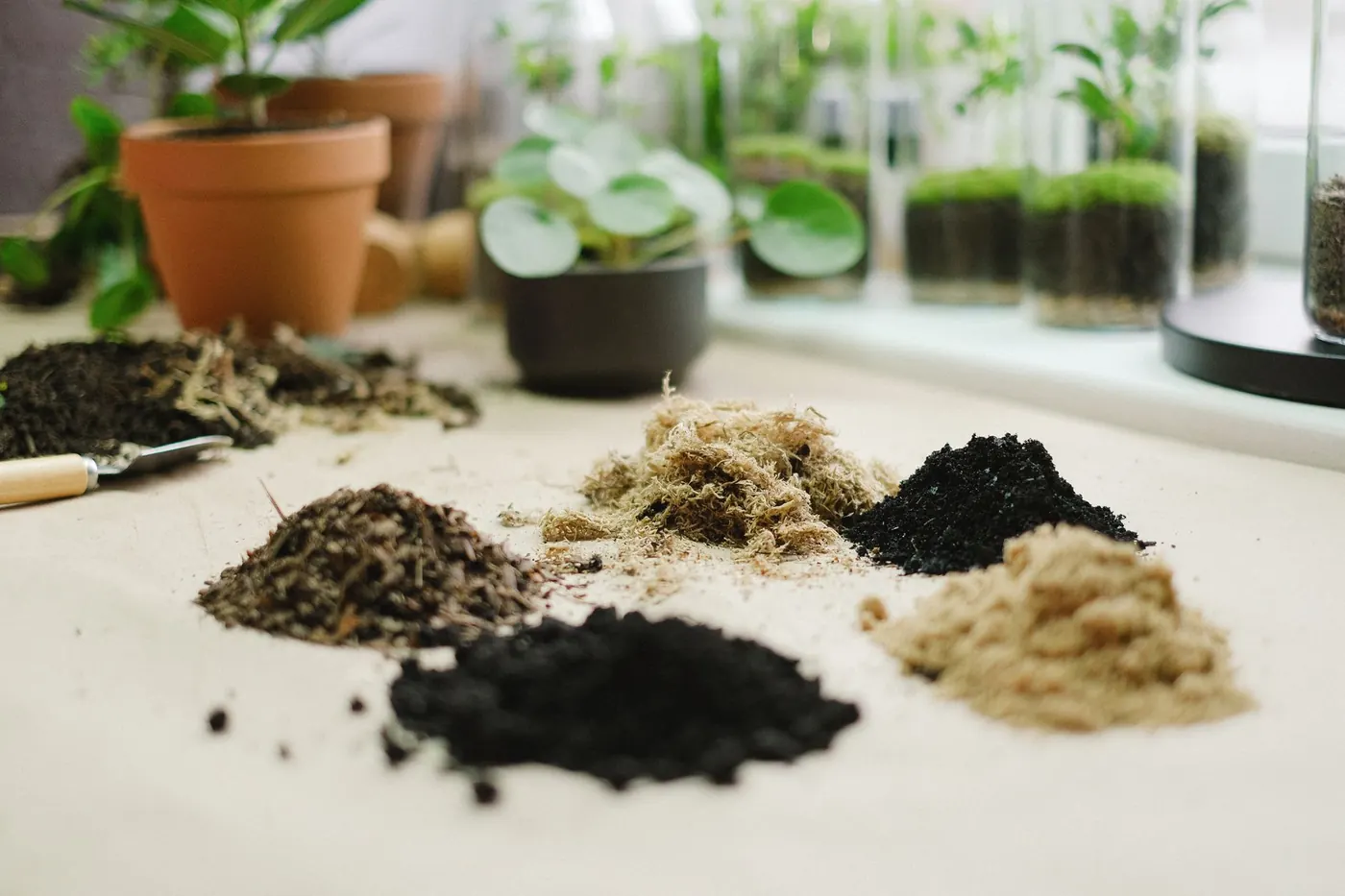
An engineered substrate assigns each particle a job. Graded pine bark gives structure and large, long-lasting air pockets because it decays slowly. Coco husk chips add air and hold a little water inside each chip. Buffered coco coir gives fine-pore water retention without peat. Coarse perlite and volcanic pumice are mineral and permanent: they never break down, so the AFP they create holds for the life of the mix, and pumice also holds water inside its pores. Horticultural charcoal adds structure and surface area. Worm castings bring a living microbial population and gentle, slow nutrition.
Changing the proportions moves the AFP to suit each root type. Our measured values run from the moisture-holding mixes to the most open:
- Calathea & Maranta Mix: 22% AFP for fine, moisture-loving terrestrial roots.
- Simply Houseplant Mix: 24% for pothos, Ficus and Peperomia.
- Alocasia Corm Mix: 26% for feeder-heavy roots needing steady moisture.
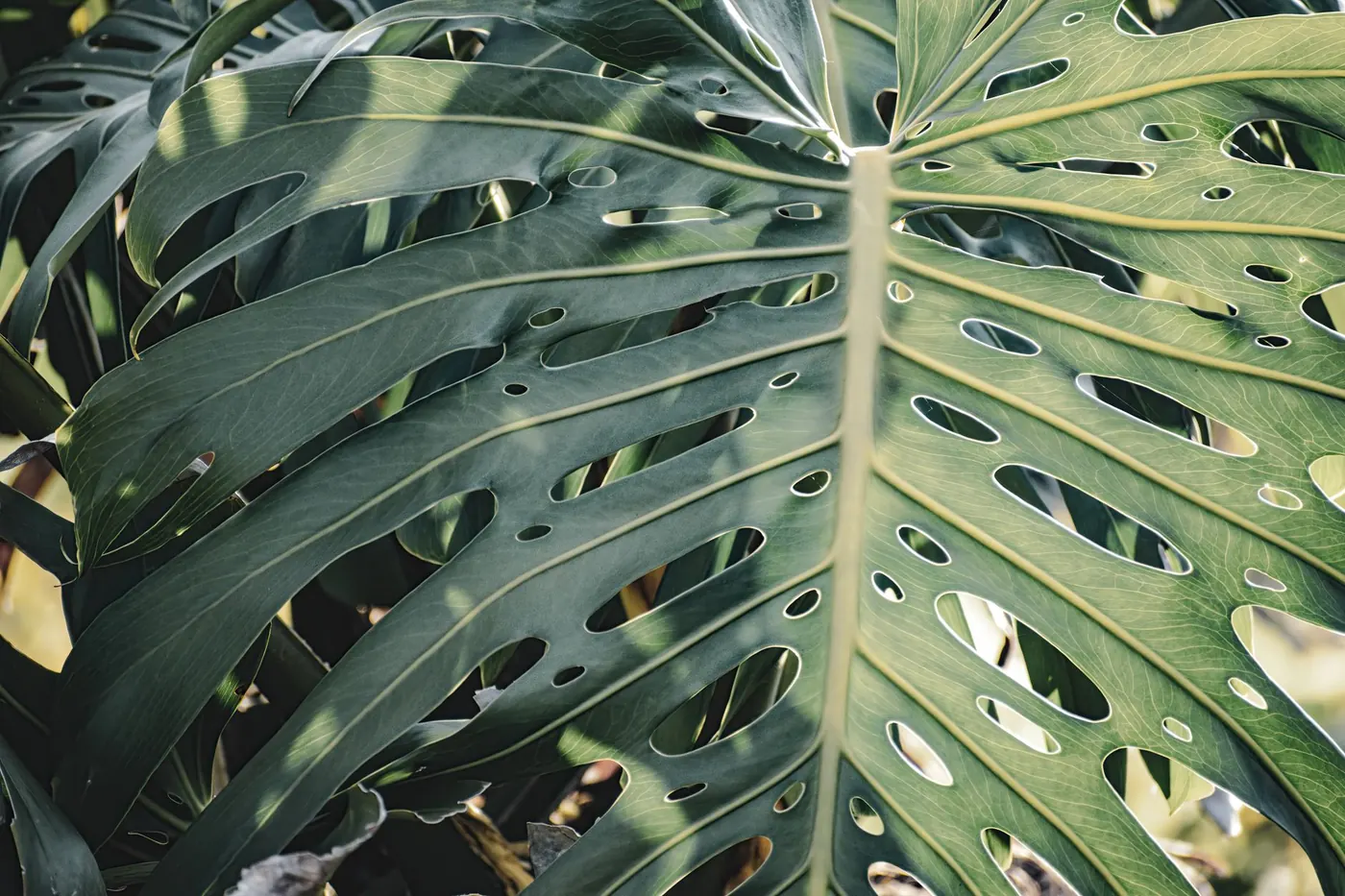
- Monstera & Philodendron Mix: 38% for thick climbing-aroid roots.
- Desert Cactus Mix: 40%, mineral-led.
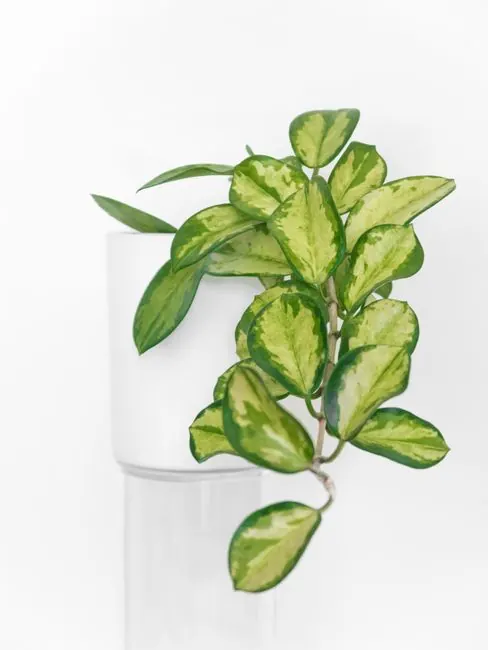
- Hoya Mix: 42% for fine epiphytic roots in small pots.
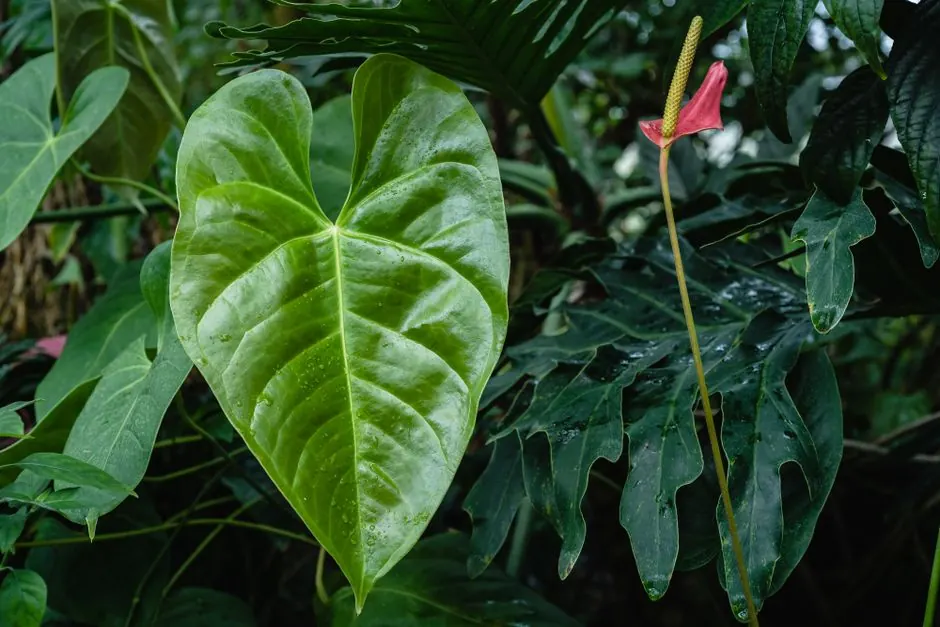
- Anthurium Epiphytic Mix: 44% for velamen-coated roots.
CEC: how a substrate holds onto nutrients
Cation exchange capacity (CEC) measures how many positively charged nutrient ions, such as potassium, calcium, magnesium and ammonium, a substrate can hold on its particle surfaces and release to roots. It is usually given in milliequivalents per 100 grams. A high-CEC substrate buffers the plant against feeding mistakes and swings in pH; a near-zero CEC substrate holds nothing, so whatever is in the water is all the roots get.
Perlite and pumice have almost no CEC. Coco coir, worm castings and composted bark carry a moderate CEC, and zeolite and vermiculite carry a high one. That is why an all-mineral mix needs regular, dilute feeding, while a mix with coir and castings tolerates a missed feed.
Coir needs one extra step. Unbuffered coir arrives with its exchange sites loaded with sodium and potassium; in the pot it swaps them for calcium and magnesium from your feed, causing deficiencies in new growth. Buffering treats the coir with a calcium solution beforehand so those sites are already occupied by calcium. All the coir in our blends is buffered.
The UK peat transition and what it means for houseplant growers
Peat bogs are the UK's largest store of land carbon, and extracting peat releases that carbon and destroys rare habitat. The UK government has committed to ending the sale of peat in amateur horticulture in England, beginning with a ban on retail sales of bagged peat compost, and expects professional horticulture to follow by the end of this decade. Scotland and Wales have consulted on their own measures. Many major retailers have already removed peat from their own-label compost.
For houseplant growers the result is more peat-free compost on the shelves, of very variable structure. Read the bag: look for a stated particle grade, named ingredients such as bark, coir, perlite and pumice, and avoid mixes listing green-waste compost and wood fibre as the main components for epiphytes. Peat itself was never ideal for aroids anyway; it collapses and becomes hydrophobic as it ages. A well-engineered peat-free mix outperforms it.
Testing AFP at home
You can measure AFP with kitchen equipment, and the protocol below is the same method we use on each blending batch, simplified. It is worth doing once with a bag of general compost and once with a chunky aroid mix: the difference is usually striking.
Read the result alongside how the mix behaves in use. A substrate measuring 25–30% suits plants that want steady moisture, such as Alocasia and Calathea, provided the pot is not oversized. Around 35–45% suits Monstera, Philodendron, Anthurium and Hoya, which tolerate a fuller wet-dry cycle. Anything above about 50% dries too fast for most tropicals indoors unless you water very frequently or grow in semi-hydro. Remember that AFP in a home test reads a little high when the mix is fresh and dry particles have not yet fully absorbed water, which is why the 30-minute soak matters, and that a mix that tests well on day one may not test well after a season if its fine fraction breaks down. Bark-mineral blends hold their numbers for two years or more; fine composts can lose half their AFP within months. If you want to blend your own, our raw components and the blend calculator give you the ratios and volumes.
Step-by-step protocol
- Seal a test potTape over the drainage holes of a 1L plastic pot from the outside so it holds water.
- Measure the pot volumeFill the sealed pot to a marked line with water, pour it into a measuring jug and record the volume; this is the container volume.
- Fill with moist substrateEmpty and dry the pot, then fill it to the same line with substrate that is evenly moist, tapping it three times to settle.
- Saturate slowlyPour water in gradually until it just reaches the surface of the substrate, and leave it for 30 minutes so particles absorb fully.
- Drain into a jugHold the pot over a clean jug, remove the tape and let it drain freely for 10–15 minutes.
- Record the drained volumeMeasure the water collected in the jug; this water was occupying the large, air-filled pores.
- Calculate AFPDivide the drained volume by the container volume and multiply by 100. A result below 10% is too dense for aroids; 25–44% suits most epiphytes.
- Repeat after settlingFor a fairer comparison, repeat the test on a mix that has been in use for three months, when fine composts have settled.
Symptoms vs root causes
| Symptom | Root cause | Action |
|---|---|---|
| Mix shrinks from the pot wall and water runs straight down the gap | Fine particles settled and the surface turned water-repellent | Repot into a structured mix; as a stopgap, bottom-water by soaking for 15 minutes. |
| Surface stays wet for a week and grows white mould | Low AFP and a deep perched water table | Switch to a 25–44% AFP mix and a pot sized to the root ball. |
| New leaves pale between veins after repotting into coir | Unbuffered coir locking up calcium and magnesium | Feed with a calcium-magnesium supplement and use buffered coir in future. |
| All-mineral mix, plant yellowing slowly despite good roots | Near-zero CEC; nothing held between feeds | Feed dilute at every watering, or add 10–20% coir or worm castings. |
| Compost smells sour within weeks of repotting | Anaerobic pockets in a dense, high-salt green-waste base | Replace the substrate before roots begin to rot. |