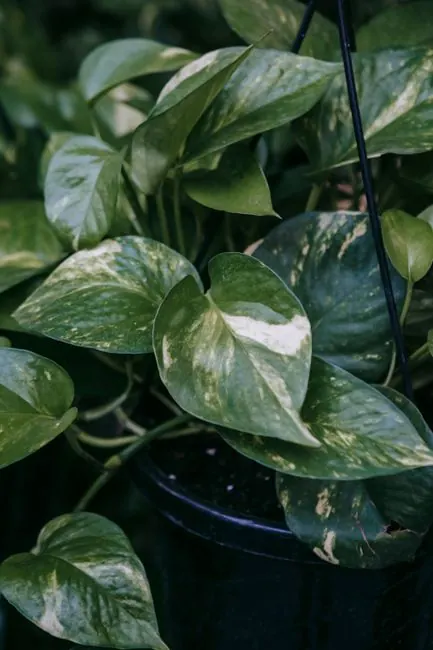
Botanical overview & native habitat
Scindapsus is a genus of about 35 climbing aroids from South East Asia and the western Pacific; Scindapsus pictus grows from Java and Borneo to the Philippines, and S. treubii is native to Borneo and Peninsular Malaysia. Epipremnum has around 15 species from South East Asia to Australia and the Pacific. Epipremnum aureum, the familiar pothos, is native to the island of Moorea in French Polynesia, and E. pinnatum is widespread across tropical Asia, with the blue-green 'Cebu Blue' form from the Philippines.
In the wild both genera climb tree trunks. Juveniles press their leaves flat against bark in overlapping rows, a habit called shingling, before growing out into larger, sometimes split adult leaves.
You can grow these plants two ways. Trailing from a shelf or hanging pot keeps them juvenile with small leaves, which suits most homes. Training them up a support brings out adult leaves: a plank of cork, cedar or a moss board fixed into the pot, kept damp, lets Scindapsus treubii and S. pictus shingle flat, each leaf larger than the last. Pin the stem against the board with plant clips until the aerial roots grip.
Scindapsus tells you when it is thirsty: leaves curl lengthwise and feel softer. Water then and they flatten within hours. Epipremnum droops slightly instead. Both are reasonably tolerant of low light, around 75 µmol/m²/s, but variegated forms such as 'Marble Queen' lose their cream in dim rooms and need 150 µmol/m²/s or more to keep it. 'Cebu Blue' needs a climbing support to produce its split adult leaves.
These are robust, fast-rooting plants that do not need a specialist blend. We grow them in Simply Houseplant Everyday Mix, a peat-free general mix with enough bark and perlite to drain well. Cuttings root in water in two to three weeks.
Feed at half strength every second watering from March to September, and repot every one to two years in spring, going up 2–3cm. In winter, water only when the pot has dried well, because cold, wet roots are the one thing these plants do not forgive. Both genera adapt well to semi-hydro and to self-watering pots filled with LECA, which suit offices where watering is irregular.
Varieties we grow and acclimatise
| Variety | Notes | From |
|---|---|---|
| Scindapsus pictus 'Exotica' | Large silver-splashed matte leaves. Curls clearly when thirsty. | £6.99 |
| Scindapsus pictus 'Argyraeus' | Smaller leaves with neat silver spots. Compact trailer for a shelf. | £5.99 |
| Scindapsus treubii 'Dark Form' | Thick, near-black glossy leaves. Shingles beautifully on a board. | £8.99 |
| Scindapsus treubii 'Moonlight' | Silver-grey leaves with a soft sheen. Slow but very tolerant. | £7.99 |
| Epipremnum pinnatum 'Cebu Blue' | Blue-green juvenile leaves that split when it climbs. | £6.99 |
| Epipremnum aureum 'Marble Queen' | Heavily streaked cream and green. Needs good light to keep the cream. | £4.99 |
| Epipremnum aureum 'Manjula' | Wavy leaves with cream, silver and green patches. Slower than other pothos. | £6.99 |
Growth stages & pricing
| Stage | Price range |
|---|---|
| In-vitro tissue culture cup | £8.99 – £14.99 |
| 6cm baby plant | £4.99 – £12.99 |
| 12cm established plant | £18.00 – £30.00 |
| 15cm+ collector specimen | £60.00 – £85.00 |
Substrate & pot
We pot every Scindapsus & Epipremnum in our Everyday Peat-Free Houseplant Base Mix (AFP 24%). Clear slotted pot or hanging basket; cork, cedar or moss board for shingling.
- Buffered Coco Coir <3mm screenedMoisture retention and an easy-to-rewet base30%
- Fine Orchiata Pine Bark 4–8mmStructure and air at root scale; slow to break down25%
- Coarse Perlite 3–6mmPermanent air space; stops the coir compacting20%
- Coco Husk Chips 6–10mmStored water with open channels between chips10%
- Organic Worm Castings <2mmSteady nutrition and microbial life10%
- Horticultural Charcoal 3–6mmRigid pores that keep the mix fresh over time5%
Troubleshooting
| Symptom | Likely cause | What to do |
|---|---|---|
| Scindapsus leaves curling lengthwise | Thirst | Water thoroughly; leaves flatten within hours. |
| Marble Queen turning mostly green | Low light | Move to 150+ µmol/m²/s; new leaves regain cream. |
| Long stems with small leaves far apart | Stretching in low light | Cut back, root the tips in water and replant to thicken the pot. |
| Yellow leaves and black stems at soil level | Overwatering in a dense mix | Take cuttings from healthy stems, discard rotten roots and restart in fresh mix. |
| Shingling stems peeling off the board | Board too dry for aerial roots to grip | Mist or soak the board daily and pin stems with clips until the roots attach. |