- From November to March, indoor light at a window commonly falls below 3 mol/m²/day, and far lower a metre or two back.
- Growth and water use drop sharply; water only when the substrate has dried, and cut or stop feeding unless under grow lights.
- Keep plants out of the rising hot air above radiators and away from cold glass at night.
- A grow light at 100–200 µmol/m²/s for 12–14 hours restores a usable daily light integral.
- Cold-shock damage appears 24–72 hours after exposure; keep the plant warm and stable and wait before cutting.
The UK winter light cliff
Great Britain sits between about 50° and 58° north, further north than most of the populated world. At the winter solstice York gets around seven hours of daylight, Edinburgh slightly less, London just under eight. The sun barely clears the rooftops at midday, and on overcast days, which in a British winter is most of them, the light that reaches a window is a small fraction of summer levels.
Plant growers measure total daily light as the daily light integral (DLI): the number of photosynthetically useful photons landing on a square metre in a day, in mol/m²/day. You can estimate it from instantaneous light intensity: DLI = PPFD (µmol/m²/s) × hours of light × 0.0036. Most tropical aroids grow steadily at a DLI of 6–12. Between November and March, a plant on a UK windowsill commonly receives less than 3 mol/m²/day, and a plant a metre or two back from the glass often less than 1. North-facing rooms and basement flats fare worst; even a south window in December delivers little on a grey day.
Below a DLI of about 2–3, most foliage plants make barely enough sugar to maintain themselves. Growth slows or stops, new leaves are smaller, and variegated plants may revert or brown on their white sections.
What plants do in a low-light winter
With little light, a plant photosynthesises less, opens its stomata less and transpires far less water. Water use can fall to a third or less of summer levels. A pot that dried in four days in July may stay wet for two weeks in January. This is the root of most winter deaths: the grower keeps watering on a summer schedule, the substrate stays saturated in a cool room, roots suffocate and Pythium moves in. Our root rot guide covers the consequences.
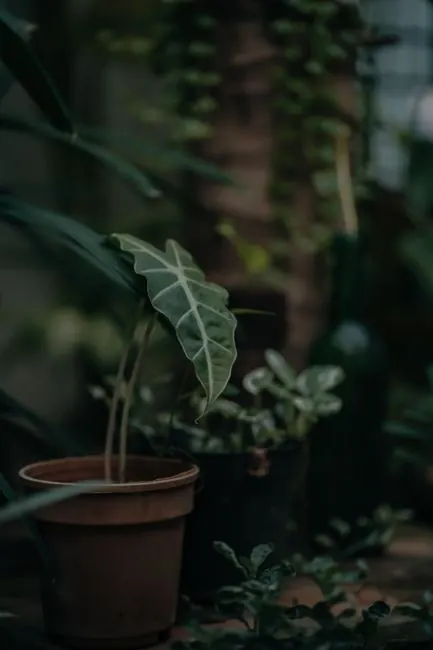
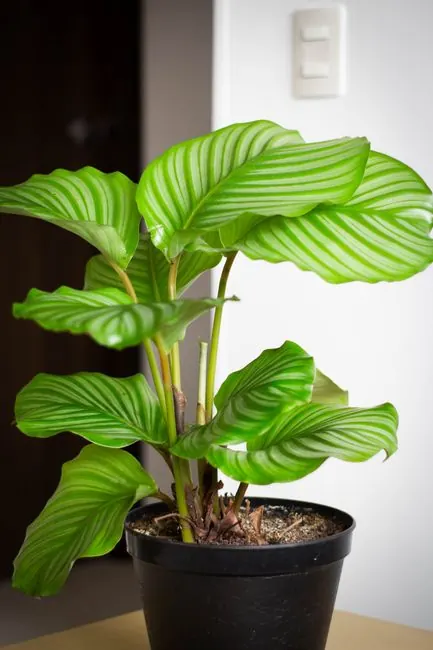
Some genera respond more dramatically. Alocasia often drops leaves and retreats into its corm in a cold, dim winter, and can look dead while being perfectly healthy. Many Calathea brown at the edges as humidity falls. Aglaonema and Dieffenbachia tolerate low light well but suffer quickly from cold, below about 13°C.
Temperature compounds the problem. Many UK homes run heating for a few hours morning and evening, so a room swings from 21°C to 14°C or lower overnight, and a windowsill swings further still. Roots in cool, wet substrate absorb water slowly and are at their most vulnerable to rot. A stable 18–22°C day and no lower than 15°C at night keeps most aroids ticking over; Anthurium and Alocasia are happiest if the night stays above 16°C. A cheap minimum-maximum thermometer on the shelf shows what your plants actually experience overnight, which is often several degrees colder than the thermostat suggests. If one room stays warmer than the rest, such as a kitchen or a home office, it is usually worth grouping the most tender plants there for the winter months.
Watering and feeding through winter
Water by the state of the substrate, never the date. Lift the pot: a dry pot is noticeably lighter. In a clear pot, look for the dark, damp band receding from the top. For most aroids, wait until the upper third to half of the substrate is dry; for Hoya, cacti and Rhipsalis, let it dry almost fully. Use water at room temperature. Cold tap water in a British winter can be below 8°C, a shock to warm roots.
Stop feeding plants that are not growing, or reduce to a quarter strength once a month for those still producing leaves. Unused fertiliser salts build up in the substrate and scorch roots. Plants under grow lights, actively growing, can continue on a normal feeding routine at a reduced rate. Postpone repotting until spring unless roots are rotting; a disturbed root system in low light recovers slowly.
Radiators, draughts and dry air
The UK habit of placing radiators under windows creates a hostile microclimate for windowsill plants. Hot air rises from the radiator past the leaves, drying them and the substrate, while at night the glass radiates cold. A plant on a sill above a radiator can see 30°C at its base during the evening and 8°C at its leaves before dawn, particularly behind single glazing or in a sash window. Closing curtains traps plants in that cold gap between curtain and glass on frosty nights.
Central heating also drops indoor humidity to 30–40%, well below the 55–70% most aroids prefer. Spider mites thrive in it, thin leaves crisp at the edges, and new leaves can stick in their sheaths. Practical fixes:
- Move plants a little back from the glass on frosty nights, or keep them on the room side of the curtain.
- Do not stand pots directly above or beside radiators; a shelf 1–2m away in the same bright room is better.
- Keep leaves from touching cold glass, where they can be chilled below 10°C.
- Group plants together, and use a humidifier for collections of Calathea, Anthurium and Alocasia. Pebble trays make little measurable difference to room humidity.
- Keep plants away from external doors opened frequently in cold weather.
Grow lights to restore usable DLI
A full-spectrum white LED grow light is the most effective winter tool for a collector. Aim for 100–200 µmol/m²/s at the leaf for 12–14 hours a day, on a timer. At 150 µmol/m²/s for 13 hours, the DLI is about 7, squarely within the growing range for aroids. Most panel and bar lights give this at 20–40cm from the canopy; check the manufacturer's PPFD chart at your mounting height rather than relying on wattage.
Plants under lights keep growing, use more water and need feeding as normal. Plants without lights should be treated as semi-dormant. Our indoor light finder estimates the PPFD and DLI at each window and distance so you can see which plants need supplementing.
Cold shock in transit and on the doorstep
Tropical plants suffer chilling injury at temperatures well above freezing. Below about 10–12°C, cell membranes in many tropical species stiffen and begin to leak, and below about 5°C the damage can be severe within hours. Symptoms rarely appear at once. Over 24–72 hours, affected tissue turns dark and water-soaked, then translucent and black, and leaves may drop.
We guard against this at dispatch. When forecast temperatures fall below 5°C, parcels travel with Winter Thermal Guard: a 72-hour heat pack and a wood-wool collar around the pot, added for £2.99 and included on specimen orders. Live plants dispatch Monday to Thursday only, so they are never held in a depot over a weekend. Details are on our shipping and guarantee page.
At your end, arrange for parcels to be taken in rather than left on a doorstep, unbox on the day of delivery and do not place a chilled plant beside a radiator; let it warm gradually in a room at 18–21°C. Do not repot for seven days. If damage appears, photograph it and contact customer care within seven days under the Live Arrival Guarantee.
Recovering frost-stressed foliage
Resist the urge to cut immediately. Chilling damage keeps expressing itself for a week or two, and tissue that looks marked on day one may recover while tissue that looked fine may collapse. Keep the plant at a stable 18–22°C in bright, indirect light, maintain moderate humidity and water sparingly; chilled roots take up water slowly and rot easily. Remove leaves only once they are clearly dead or turning mushy, using a sterilised blade. A plant with a healthy growing point and sound roots will replace lost leaves when light and temperature allow, often not until spring.
Step-by-step protocol
- Unbox on arrivalOpen the parcel on the day it arrives and remove packaging gently, keeping any heat pack away from leaves.
- Warm graduallyPlace the plant in a room at 18–21°C away from radiators and direct heat so it warms over several hours.
- Check the substrateWater only if the substrate is dry, using room-temperature water; do not repot for seven days.
- Photograph any damageIf dark, water-soaked patches appear within 24–72 hours, photograph them and contact customer care within seven days.
- Wait before cuttingKeep the plant stable for one to two weeks and remove only leaves that are clearly dead or mushy, with a sterilised blade.
- Set a winter positionChoose a bright spot 1–2m from radiators, off cold glass and on the room side of curtains at night.
- Adjust water and feedWater only when the upper third to half has dried and stop feeding unless the plant is growing under lights.
- Add supplementary lightRun a full-spectrum LED at 100–200 µmol/m²/s for 12–14 hours to lift DLI back above 5–6.
Symptoms vs root causes
| Symptom | Root cause | Action |
|---|---|---|
| Dark, water-soaked patches two days after delivery | Chilling injury in transit or on the doorstep | Warm gradually, keep stable, photograph and report within seven days. |
| Lower leaves yellowing and substrate wet for a fortnight | Summer watering carried into low winter light | Let the substrate dry further between waterings; check roots if it persists. |
| Crisp brown leaf edges on Calathea from December | Central heating dropping humidity to 30–40% | Move away from radiators and add a humidifier. |
| Alocasia losing leaves one by one in winter | Dormancy triggered by low light and cooler temperatures | Keep barely moist and warm; the corm will regrow in spring. |
| Leggy stems and small new leaves | DLI below 3 mol/m²/day | Move closer to the window or add a grow light. |
| Leaves touching the window turn black at the edges | Contact with cold glass overnight | Keep foliage off the glass and move plants back on frosty nights. |