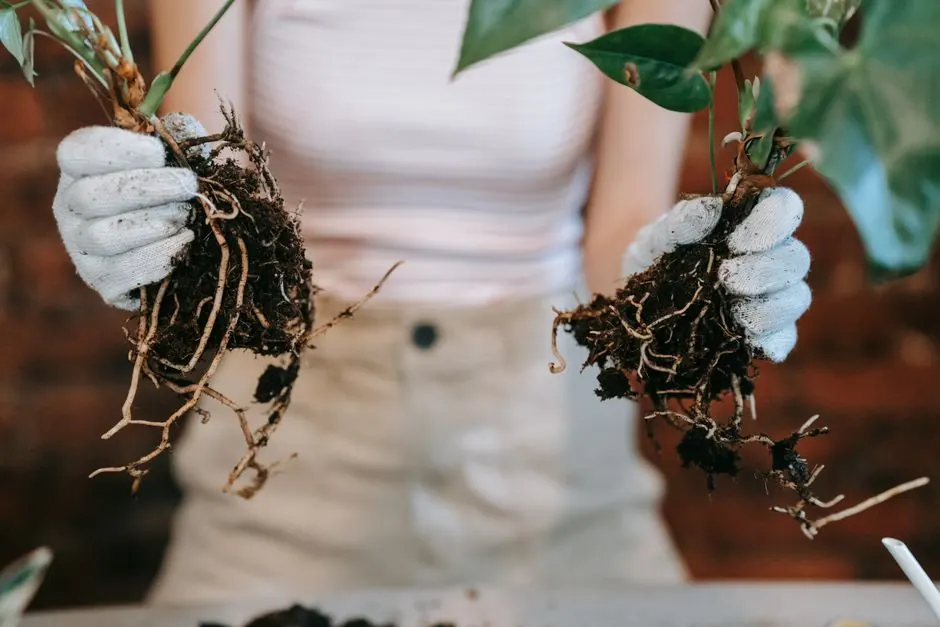
- Most root rot in houseplants is caused by the water moulds Pythium and Phytophthora, which thrive where roots are short of oxygen.
- Healthy aroid roots are firm and white to cream; rotten roots are brown or black, mushy and slough off a wiry core.
- Cut back to firm tissue with a sterilised blade, sterilising again between cuts.
- Use a dilute hydrogen peroxide dip once on bare roots; use enzyme flushes for ongoing recovery. Never apply them together.
- Repot into a smaller clear pot and a chunky, high-AFP mix, then water only when the upper third has dried.
What root rot actually is
Roots respire. They burn sugar and need oxygen to do it, and oxygen moves through water roughly ten thousand times more slowly than through air. When every pore in a substrate fills with water and stays full, roots suffocate within days. Their cells begin to die and leak sugars, and that is the opening for the organisms we call root rot.
The usual culprits in UK homes are Pythium and Phytophthora. They are not true fungi but oomycetes, or water moulds, and they spread by swimming spores that move through water-filled pore space. A saturated, fine-textured compost is ideal for them; an open, chunky mix with plenty of air-filled porosity is close to hostile. Fusarium and Rhizoctonia also cause rots, and bacterial soft rot often follows once tissue has collapsed.
So the treatment has two halves. Remove the infected tissue, and change the conditions that let it happen: the substrate, the pot and the watering routine. Pruning without fixing the substrate simply restarts the clock.
Reading the roots: healthy velamen versus rot
Many of the plants collectors grow, including Anthurium, Monstera, Philodendron and most epiphytic aroids, have roots covered in a spongy outer layer of dead cells called velamen. It soaks up water quickly and protects the living root inside. Healthy velamen is firm, white to cream or silvery when dry and turns faintly green or translucent when wet. Growing tips are pale, pointed and slightly glossy. Squeeze a healthy root between finger and thumb and it springs back. The root ball smells of damp woodland, if it smells of anything.
Rot looks and feels different. Infected roots turn tan, brown or black, feel wet and collapse when squeezed. Pull gently and the outer cortex slides away, leaving a thin, wiry strand: the central vascular core, which is all that remains of a dead root. The smell is sour, fermented or sewage-like. Rot usually begins at the bottom of the pot, where the perched water sits longest, and works upward.
Do not confuse rot with harmless conditions. Dry, papery brown roots that crumble rather than squash are desiccated, not rotten, and are common after an Alocasia drops into dormancy. The small white storage tubers on Calathea roots are normal. Old roots on mature aroids naturally darken to light brown but stay firm.
Surgical pruning back to clean tissue
Lift the plant out and remove every bit of the old substrate. Soak the root ball in a bucket of tepid water and work it loose with your fingers; a gentle tap rinse finishes the job. You need to see every root to judge it, and old compost carries spores.
Sterilise a sharp blade or snips with 70% isopropyl alcohol. Cut each diseased root back to firm, white or cream tissue, then go a further 0.5–1cm into healthy root, because infection travels ahead of the visible damage. Sterilise the blade again between cuts on a badly affected plant. Be ruthless: a small, clean root system recovers; a larger one with rotten sections left in it does not.
Check the stem base. If the rot has reached the stem and it is soft or discoloured inside when you cut, the root system is beyond saving. Take cuttings from healthy stem above the damage, each with at least one node, and root them in sphagnum or water while you decide whether the base is worth keeping.
3% hydrogen peroxide or an enzyme flush?
Hydrogen peroxide sold at 3% breaks down into water and oxygen. As it does, it oxidises organic material and kills water mould spores and bacteria on contact. It is useful immediately after surgery, as a dip on bare, cleaned roots: dilute one part 3% peroxide with three to four parts water and soak for five to ten minutes. It is indiscriminate, though. It kills beneficial microbes along with pathogens and can scorch fine new root tips, so we use it once, on bare roots, and do not pour it repeatedly through a potted organic mix.
Enzyme root treatments work differently. They contain enzymes, mainly cellulases, that digest dead root material without harming living tissue, removing the decaying debris that feeds pathogens. They are gentle, compatible with beneficial microbes and suitable for repeated use while new roots form. We apply an enzyme flush at label rate at every second watering for the first six to eight weeks after a reset.
Use them in sequence, never together. Peroxide oxidises the enzymes and neutralises them. Peroxide for the acute moment on bare roots; enzymes for the recovery that follows.
The bare-root reset into a high-AFP mix
Size the new pot to the roots that survived, not to the plant above them. A plant that has lost half its roots usually goes down a pot size. Excess substrate around a small root system stays wet, and that is how rot returns. Use a clear slotted pot so you can watch recovery without lifting the plant.
Choose a chunky, high-AFP mix: the Anthurium Epiphytic Mix at 44% AFP for velamen-rooted epiphytes, the Monstera & Philodendron Mix at 38% for climbing aroids, or the Alocasia Corm Mix for feeder-heavy roots that need steadier moisture. Air-filled porosity is the share of the pot volume still holding air after it has drained, and it is the single most important number for a recovering plant. Our substrate science guide explains why.
Hold the plant at its original depth, trickle the mix around the roots and tap the pot to settle it rather than pressing. Water in lightly. Then wait until the upper third of the mix is dry before watering again. Keep the plant at 20–24°C in bright, indirect light, raise air humidity rather than substrate moisture, and support a top-heavy plant with a stake while it has few anchoring roots. New root tips usually appear at the pot wall within three to six weeks.
Preventing a second round
Nearly every case we see at the nursery traces back to one of four habits: a fine compost that holds no air, a pot several sizes too big, a decorative cachepot holding standing water, or a summer watering routine carried into winter. Our guides to pot choice and winter care cover the last three in detail. Water by the state of the substrate, not the calendar, and the problem rarely comes back.
Genus-specific recovery notes
Different root systems fail and recover in different ways, and the reset should follow the plant rather than a single recipe.
- Anthurium: thick velamen roots rot from the tip backwards and recover slowly. Keep every firm root, however short, and reset in the most open mix you have. Anchor the plant firmly, because movement snaps new tips.
- Monstera and Philodendron: climbing aroids usually carry aerial roots above the soil line. If the underground roots are lost, these aerial roots can be guided into fresh mix and will often take over, which is a faster route to recovery than waiting for new basal roots.
- Alocasia: if the roots have gone but the corm is firm, clean it, dry the surface for an hour and set it half-buried in damp sphagnum or perlite at 22–25°C. New roots and a leaf often follow within a month. Check the base of the plant for small offset corms worth saving separately.
- Calathea and Maranta: fine fibrous roots rot fast and suffer when dried out. Prune, skip the peroxide dip if very few roots remain, and reset in the moisture-retentive Calathea & Maranta Mix rather than a chunky aroid blend.
- Hoya: rot in a Hoya usually means the pot is too large. Go down to the smallest pot the roots fit and use the fast-draining Hoya Mix.
Step-by-step protocol
- Confirm the diagnosisLift the plant from its pot and inspect the roots; brown, mushy roots that slough off a wiry core and smell sour confirm rot.
- Remove all old substrateSoak the root ball in tepid water and work every particle of old compost away, finishing with a gentle rinse.
- Prune to clean tissueWith a blade sterilised in 70% isopropyl alcohol, cut each diseased root back to firm tissue plus a further 0.5–1cm, re-sterilising between cuts.
- Check the stem baseIf the stem is soft or discoloured inside, take cuttings from healthy stem above the damage and root them separately.
- Dip in dilute peroxideSoak the bare roots for 5–10 minutes in one part 3% hydrogen peroxide to three or four parts water, once only.
- Choose a smaller clear potPick a clear slotted pot sized to the remaining roots, usually one size down from the original.
- Repot in a high-AFP mixSet the plant at its original depth in a chunky mix of 26–44% AFP matched to the genus, settling it by tapping rather than pressing.
- Water sparingly and flush with enzymesWater in lightly, then only when the upper third is dry, adding a label-rate enzyme flush at every second watering for six to eight weeks.
Symptoms vs root causes
| Symptom | Root cause | Action |
|---|---|---|
| Lower leaves yellowing while the substrate stays wet | Roots suffocating in a low-AFP mix; early rot | Unpot and inspect; if roots are firm, repot into a chunkier mix and water less often. |
| Plant wilting despite a heavy, damp pot | Root system lost; no uptake possible | Full bare-root reset with surgical pruning, or cuttings if the stem is affected. |
| Black, wet patches spreading from leaf margins or petiole bases | Advanced rot or secondary bacterial infection | Remove affected leaves with a sterile blade, then check the root zone immediately. |
| Sour or sewage smell from the pot | Anaerobic substrate and decaying roots | Discard the substrate entirely and reset the plant in fresh, open mix. |
| Fungus gnats appearing alongside yellowing | Constantly wet organic substrate; larvae feed on decaying roots | Fix drainage and dry the top layer; see the biological control guide. |
| Dry, papery brown roots on an Alocasia in winter | Dormancy dieback, not rot | Keep barely moist and warm; new roots return from the corm in spring. |