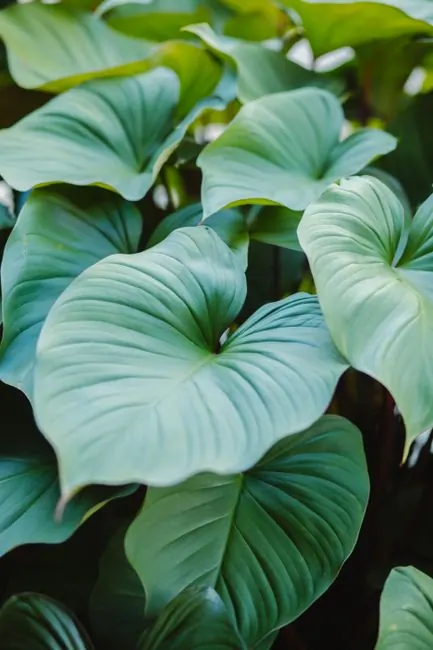
Botanical overview & native habitat
Philodendron holds around 500 accepted species spread from Mexico to northern Argentina, most of them in the wet forests of Colombia, Ecuador, Peru and Brazil. Growth habit varies more than in any other houseplant genus. Climbers such as Philodendron melanochrysum, P. verrucosum and P. billietiae root up tree trunks and size up dramatically with height. Crawlers such as P. gloriosum creep along the forest floor on a thick horizontal rhizome, rooting downward as they go.
Philodendron spiritus-sancti is endemic to a few forest fragments in Espírito Santo, Brazil, and is critically rare in the wild; the plants now in UK collections come from tissue culture, not wild collection.
Decide first whether you have a climber or a crawler. Climbers want a moss pole from the 12cm stage, with aerial roots tied against damp sphagnum. Crawlers want the rhizome sitting on the surface, never buried: grow P. gloriosum in a rectangular trough 30–40cm long and only 12–15cm deep, with the old end against one wall so the growing tip has room to travel. A round pot forces the rhizome to the rim within a year, and burying it is the commonest cause of rhizome rot.
Velvet-leaved species (melanochrysum, verrucosum, gloriosum) need 65–80% humidity to open new leaves cleanly; below that, a new leaf can stick in its sheath and tear. A cabinet or a large humidifier in a small room works better than misting. 'Pink Princess' and 'White Wizard' carry unstable variegation: prune back to a balanced node if a stem goes all green, and expect all-pink leaves to die back because they cannot photosynthesise.
All our philodendrons grow in chunky aroid mix. For velvets we add a 2cm sphagnum top-dress to keep surface humidity up without wetting the root zone.
Buying by stage matters more with Philodendron than most genera. Tissue culture cups are the cheapest route into P. spiritus-sancti and P. verrucosum, but velvet plantlets wean slowly and need a closed box for the first month. A 12cm established plant has already made the switch to open air and usually has its first aerial roots, which makes it the easiest stage to fit to a pole. Feed at half strength from March to September; velvet leaves mark easily from salts, so flush with rainwater monthly in hard-water areas.
Varieties we grow and acclimatise
| Variety | Notes | From |
|---|---|---|
| Philodendron erubescens 'Pink Princess' | Dark leaves splashed pink. Balanced variegation needs 200+ µmol/m²/s; all-pink leaves do not last. | £12.99 |
| Philodendron 'White Wizard' | Green and white chimeral climber. Vigorous once established on a pole. | £14.99 |
| Philodendron 'Florida Ghost' | Lobed leaves that emerge almost white and green up over weeks. Not variegation, so it will not revert. | £9.99 |
| Philodendron melanochrysum | Black-gold velvet climber with leaves that pass 60cm on a pole. Wants 70%+ humidity. | £14.99 |
| Philodendron verrucosum | Velvet leaves with hairy petioles from Andean cloud forest. Dislikes temperatures above 28°C. | £16.99 |
| Philodendron gloriosum | Heart-shaped velvet crawler with white veins. Grow it in a shallow trough with the rhizome on top. | £16.99 |
| Philodendron billietiae | Long strap leaves on bright orange petioles. A fast, forgiving climber. | £12.99 |
| Philodendron spiritus-sancti | Long pendant leaves, critically rare in the wild. Available as tissue culture plantlets. | £34.99 |
Growth stages & pricing
| Stage | Price range |
|---|---|
| In-vitro tissue culture cup | £8.99 – £34.99 |
| 6cm baby plant | £6.99 – £18.00 |
| 12cm established plant | £22.00 – £55.00 |
| 15cm+ collector specimen | £60.00 – £195.00 |
Substrate & pot
We pot every Philodendron in our Monstera & Philodendron Chunky Aroid Mix (AFP 38%). Climbers: clear slotted pot with a moss pole from 12cm. Crawlers: shallow rectangular trough 30–40cm long, 12–15cm deep.
- Orchiata Pine Bark 12–18mmStructural air pockets between particles; lignin-rich, so it holds its shape for 18–24 months30%
- Coco Husk Chips 8–12mmHolds water inside each chip while leaving air channels between them20%
- Coarse Perlite 3–6mmPermanent lightweight air space that never decomposes15%
- Volcanic Pumice 4–8mmMineral skeleton with internal pores; adds weight to stabilise plants on moss poles15%
- Horticultural Charcoal 5–10mmStable macropores and adsorption of some organic breakdown compounds10%
- Organic Worm Castings <2mmSlow-release nitrogen, microbial life and cation exchange capacity10%
Troubleshooting
| Symptom | Likely cause | What to do |
|---|---|---|
| New velvet leaf stuck in its sheath or torn on opening | Humidity below 60% while the leaf expands | Raise humidity to 70% for the two weeks a leaf takes to open; a cabinet or a clear bag over the leaf both work. |
| Soft brown rot at the back of a crawler rhizome | Rhizome buried under substrate | Cut back to firm tissue, dust with cinnamon or charcoal and reset the rhizome on the surface. |
| Long gaps between leaves on a climber | Too little light, the plant is stretching | Increase light to at least 150 µmol/m²/s and give the stem a pole to root into. |
| Pink Princess reverting to all-dark leaves | Variegation lost on that stem | Cut above the last node with balanced pink and green; the new bud often restores it. |
| Yellow leaves with brown, wet roots | Compacted or over-fine substrate | Follow the root rot protocol and repot into chunky aroid mix in a clear pot. |