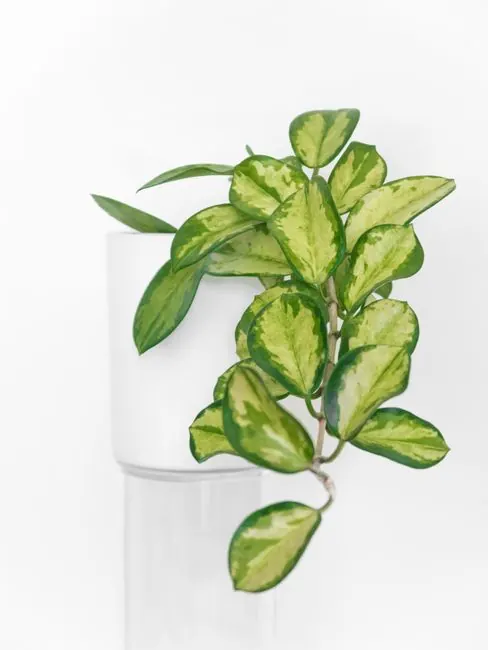
Botanical overview & native habitat
Hoya is a genus of 500 or more species in the milkweed subfamily of Apocynaceae, ranging from India and southern China through South East Asia to Australia and the Pacific islands. Most are epiphytic vines that climb tree trunks with roots tucked into bark crevices and moss, where water drains away within minutes and the roots dry between storms. Thick, waxy leaves store water through dry spells. Hoya linearis is an exception, growing at altitude in the Himalayan foothills, where it hangs from mossy branches in cooler, consistently damp air.
Hoyas flower from peduncles, short spurs that appear at leaf nodes and produce an umbel of waxy, star-shaped flowers, often scented in the evening. The same peduncle blooms again in later seasons, so never cut one off after flowering. A plant flowers when it is mature, has bright light, typically a daily light integral of 8 mol/m²/day or more, and is slightly pot-bound. In most UK homes that means an east, west or south window, with a net curtain against midday summer sun. Long leafless tendrils are normal: they are searching for something to climb, and leaves follow once they attach.
Watering is the main skill. Thick-leaved species such as Hoya kerrii and H. carnosa want the mix to dry right through; give them a slight squeeze and water when leaves feel softer. Thin-leaved species such as H. linearis want steadier moisture. Over-watering in winter, not under-watering, kills most hoyas in the UK.
Our hoyas grow in Hoya Epiphytic Bark Mix: bark, pumice and coir chips that dry in days, not weeks. A small terracotta or clear pot two sizes smaller than you would choose for an aroid is about right.
Feed every second watering from April to September with a balanced fertiliser at half strength, switching to a higher-potassium feed once peduncles appear. Propagation is easy from stem cuttings with two nodes, rooted in water, perlite or sphagnum, but a leaf on its own rarely produces a stem: the single-leaf kerrii sold around Valentine's Day can live for years without ever growing. Most hoyas need two to three years from a rooted cutting before they flower.
Varieties we grow and acclimatise
| Variety | Notes | From |
|---|---|---|
| Hoya carnosa 'Compacta' | The Hindu rope: tightly curled leaves on pendant stems. Slow, but flowers well when mature. | £7.99 |
| Hoya kerrii | Heart-shaped succulent leaves. Single-leaf cuttings rarely grow on; buy a rooted vine. | £6.99 |
| Hoya linearis | Soft, pencil-thin leaves on long hanging stems. Cooler and more humid than other hoyas. | £9.99 |
| Hoya 'Mathilde' | Speckled carnosa x serpens hybrid that flowers young. A good first bloomer. | £8.99 |
| Hoya callistophylla | Long leaves with dark, netted veins. Likes warmth and 60% humidity. | £12.99 |
| Hoya latifolia | Broad, leathery leaves; vigorous once settled. Needs a trellis or hoop. | £11.99 |
Growth stages & pricing
| Stage | Price range |
|---|---|
| Rooted cutting plug (5cm) | £4.99 – £9.99 |
| 6cm baby plant | £6.99 – £14.99 |
| 12cm established plant | £18.00 – £35.00 |
| 15cm+ collector specimen | £60.00 – £120.00 |
Substrate & pot
We pot every Hoya in our Hoya & Epiphytic Vine Fast-Drain Mix (AFP 42%). Small clear or terracotta pot kept snug; trellis, hoop or hanging basket.
- Orchiata Pine Bark 6–12mmOpen structure scaled for small pots and fine roots35%
- Volcanic Pumice 4–8mmPermanent porosity and weight; wicks a little moisture through the pot25%
- Coco Husk Chips 6–10mmWater held within the chip, released slowly20%
- Horticultural Charcoal 4–8mmRigid air spaces; keeps the mix sweet in small, slow-drying pots10%
- Coarse Perlite 3–6mmLight air space at the surface5%
- Organic Worm Castings <2mmGentle nitrogen and microbial life5%
Troubleshooting
| Symptom | Likely cause | What to do |
|---|---|---|
| Never flowers | Too little light or the plant is still juvenile | Move to a brighter window or add a grow light for a DLI of 8 or more; keep it slightly pot-bound. |
| Flower buds drop before opening | Moving the plant or a sudden dry spell while in bud | Do not turn or move the pot once buds form, and water steadily. |
| Leaves soft, yellow and translucent | Root rot from wet mix in winter | Unpot, cut away dark roots and repot into dry bark mix; water sparingly until new growth. |
| Wrinkled, limp leaves with dry mix | Under-watering | Soak the pot for 10 minutes and drain; leaves firm up in a day or two. |
| White, cottony spots in leaf axils | Mealybugs | Dab with isopropyl alcohol on a cotton bud and repeat weekly for a month. |