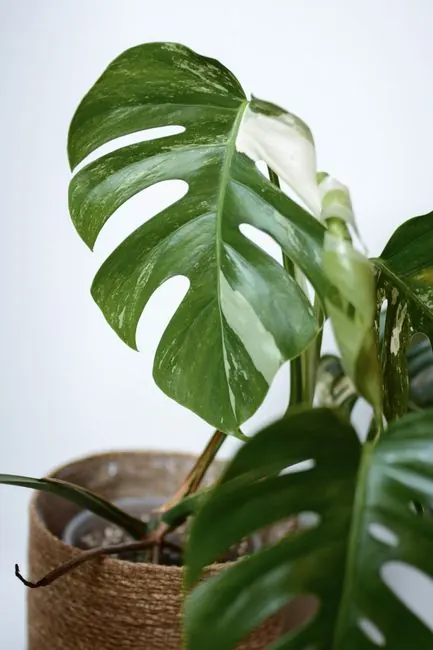
A specimen is a plant that has finished the risky part of its life. It has been through tissue culture or propagation, been grown on in our glasshouses in York, rooted fully into a chunky peat-free aroid mix, and produced several leaves at our conditions rather than a laboratory's or an importer's. At this size a Monstera deliciosa 'Thai Constellation' or an Alocasia micholitziana 'Frydek Variegata' is far more tolerant of a missed watering or a cool night than a cup of plantlets. That reliability is what the price pays for.
What qualifies as a specimen
Every plant in this category meets four checks before it is listed. It is in a 15cm pot or larger. It carries a minimum number of fully hardened leaves for its genus, typically five or more for Monstera and Philodendron and three or more for Alocasia and Anthurium. Its roots have been inspected through the clear pot and fill the root ball without circling or browning. And it has spent at least four weeks on our quarantine and acclimatisation benches under biological pest control, after which it receives its UK Plant Passport.
We photograph each specimen individually in natural light and the listing shows the plant you will receive. Variegation is never identical from leaf to leaf, and the photo is the only honest way to sell it.
Stable, chimeral and what you are paying for
Variegation is not one thing. 'Thai Constellation' is a stable mutation carried in every cell; it does not revert and its pattern stays broadly consistent. Monstera deliciosa 'Albo Variegata', Philodendron 'White Wizard' and 'Frydek Variegata' are chimeras, where white and green tissue sit side by side in the growing point. Their pattern shifts with every leaf: a stem can drift towards all-green, which you correct by cutting back to a well-variegated node, or towards all-white, which cannot photosynthesise and eventually fails.
Pricing reflects this. A chimera with balanced variegation on several consecutive leaves and on the newest growth commands more than one with a single dramatic leaf, because the newest leaf is the best predictor of the next. When comparing listings, look at the most recent leaf and the node it came from, not the most photogenic one.
Specimen care for the first 30 days
Do not repot for at least seven days after arrival; this is also a condition of the guarantee. Place the plant where it will live: for variegated aroids that means 200–400 µmol/m²/s, typically within 1–2m of an east, south or west window with a net curtain against hot summer sun. Variegated tissue scorches before green tissue does.
Hold humidity at 55–70% and temperatures at 18–27°C. Water when the top 3–5cm of mix is dry, checking roots through the clear pot rather than following a calendar. Expect one older leaf to yellow in the first fortnight as the plant adjusts to your light; that is normal. If you plan to move it to a larger pot or a moss pole, do it after the first new leaf has opened at home. The Monstera, Philodendron, Alocasia and Anthurium guides give genus-specific targets.
Packing and winter shipping
Specimens are wrapped at the stem and pot, braced inside a double-walled box so the root ball cannot shift, and sent Monday to Thursday only. The Winter Thermal Guard, a 72-hour heat pack with a wood-wool collar, is included free on specimen orders whenever overnight temperatures fall below 5°C, and we hold orders at the nursery when forecasts exceed 32°C. Most specimen orders qualify for free Priority next-working-day delivery, which applies over £150. Read the full terms on our shipping and guarantee page.