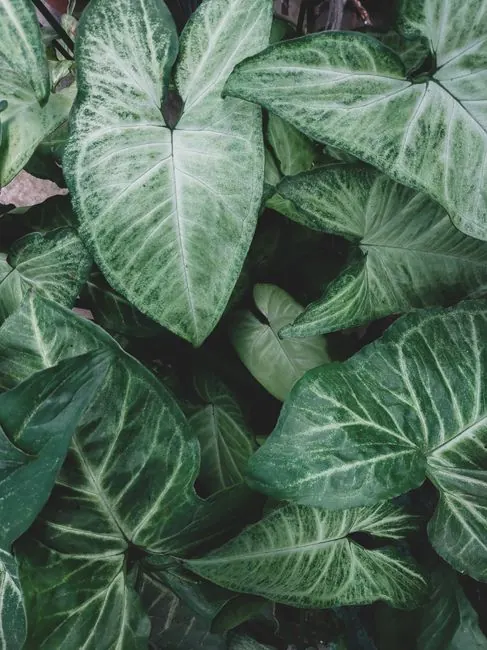
Botanical overview & native habitat
Syngonium comprises about 35 species of hemiepiphytic aroids from Mexico and the Caribbean to Bolivia and southern Brazil. Like Monstera, seedlings creep across the forest floor until they find a trunk, then climb. As they climb the leaf form changes completely: the arrow-shaped juvenile leaf of Syngonium podophyllum becomes a deeply divided, hand-like adult leaf with five to eleven leaflets. Stems produce milky latex and root readily at every node, which is how wild plants spread when a climbing stem breaks and falls to the forest floor.
Most UK growers want the juvenile arrow shape. Keep it by growing the plant as a bushy pot plant and pinching or cutting stems that start to climb or trail; cuttings root in water or moss in two to three weeks and can go back into the same pot to thicken it. Given a pole, the plant will climb and switch to adult lobed leaves, which some collectors prefer.
Variegation behaves differently by cultivar. Syngonium podophyllum 'Albo Variegatum' is a chimera with white sectors and reverts like Monstera Albo; cut back to a well-variegated node. 'Mojito' carries marbled cream and is fairly stable. 'Pink Splash', 'Milk Confetti' and 'Red Spot Tricolor' carry pink pigment that strengthens in brighter light and fades towards green in a dim room. Aim for 150–300 µmol/m²/s to keep colour, avoiding direct summer sun that bleaches pink leaves.
Syngoniums grow fast and drink a lot in summer. We pot them in Monstera & Philodendron Chunky Aroid Mix, which holds enough water for a growing vine while draining well in winter.
Propagation is the easiest of any aroid here. Any stem section with a node roots in water within two to three weeks, and variegated cuttings keep the pattern of the node they came from. Feed at half strength every second watering in spring and summer; a hungry Syngonium produces smaller, paler leaves. In winter growth slows sharply in UK light, so water only when the top 3cm is dry and expect the odd older leaf to yellow. Small Syngoniums also suit semi-hydro and mixed terrarium planting, because they tolerate high humidity and root readily into new media.
Varieties we grow and acclimatise
| Variety | Notes | From |
|---|---|---|
| Syngonium podophyllum 'Albo Variegatum' | White sectoral variegation on a chimera. Prune reverted stems promptly. | £12.99 |
| Syngonium podophyllum 'Mojito' | Marbled cream and green, each leaf different. More stable than Albo. | £8.99 |
| Syngonium podophyllum 'Pink Splash' | Dark green leaves speckled pink. Colour deepens with brighter light. | £6.99 |
| Syngonium podophyllum 'Milk Confetti' | Pale pink and cream blush on soft green. Compact and bushy. | £6.99 |
| Syngonium podophyllum 'Red Spot Tricolor' | Pink, cream and green on the same leaf. Needs good light to hold all three. | £9.99 |
| Syngonium podophyllum 'Neon Robusta' | Solid pink leaves on a vigorous plant. Pink holds best out of direct sun. | £5.99 |
Growth stages & pricing
| Stage | Price range |
|---|---|
| In-vitro tissue culture cup | £8.99 – £19.99 |
| 6cm baby plant | £4.99 – £14.99 |
| 12cm established plant | £18.00 – £35.00 |
| 15cm+ collector specimen | £60.00 – £95.00 |
Substrate & pot
We pot every Syngonium in our Monstera & Philodendron Chunky Aroid Mix (AFP 38%). Clear slotted pot; prune for a bushy shape or add a moss pole for adult leaves.
- Orchiata Pine Bark 12–18mmStructural air pockets between particles; lignin-rich, so it holds its shape for 18–24 months30%
- Coco Husk Chips 8–12mmHolds water inside each chip while leaving air channels between them20%
- Coarse Perlite 3–6mmPermanent lightweight air space that never decomposes15%
- Volcanic Pumice 4–8mmMineral skeleton with internal pores; adds weight to stabilise plants on moss poles15%
- Horticultural Charcoal 5–10mmStable macropores and adsorption of some organic breakdown compounds10%
- Organic Worm Castings <2mmSlow-release nitrogen, microbial life and cation exchange capacity10%
Troubleshooting
| Symptom | Likely cause | What to do |
|---|---|---|
| Pink cultivars turning green | Light too low for pigment production | Move to 150–300 µmol/m²/s; new leaves colour up, older ones will not. |
| Long bare stems with small leaves | Stretching in low light | Cut back to two nodes, root the tips and replant them in the same pot. |
| Leaves changing from arrow shape to lobed | The plant has started climbing | Normal adult growth. Prune back if you prefer juvenile arrows. |
| Brown leaf tips | Dry air or letting the mix dry out completely | Water before the pot is fully dry and keep humidity above 50%. |
| Fine webbing under leaves | Spider mites | Shower the plant and introduce predatory mites; raise humidity. |