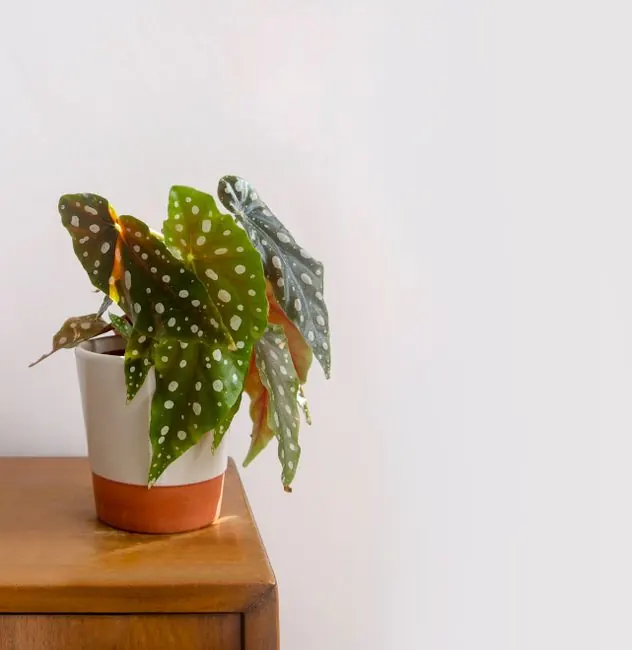
Botanical overview & native habitat
Begonia is one of the largest flowering plant genera, with around 2,000 species across tropical Central and South America, Africa and Asia. Begonia maculata and B. luxurians are cane and shrub types from Brazil's Atlantic forest, growing in dappled light along stream banks. Begonia darthvaderiana and B. amphioxus come from Borneo, where they grow in deep shade on wet forest floors and rock faces in near-saturated air. Begonia ferox grows in limestone karst in northern Vietnam and southern China, with puckered, spiny leaves that catch moisture.
For care, split begonias into three groups. Cane and shrub types, such as B. maculata and B. luxurians, are windowsill plants: bright light without hot sun, 50–60% humidity and a mix that dries slightly between waterings. Pinch the tips each spring to make a bushier plant. Rex and rhizomatous begonias sit in the middle, wanting 60–70% humidity and shallow pots, with the rhizome on the surface.
The third group, the terrarium species, includes B. darthvaderiana, B. amphioxus and B. ferox. They want 80–95% humidity, temperatures of 20–25°C and low light, around 50–100 µmol/m²/s, which a small LED over a closed glass tank supplies easily. In open room air their leaves curl and crisp within days. Ventilate the tank for a few minutes daily to keep air moving, because still, saturated air with dead leaf debris invites botrytis.
All begonias have fine, fibrous roots that rot in a dense mix. We grow them in Terrarium & Vivarium ABG Mix, which holds moisture in bark fines, fern fibre and sphagnum while staying open. Powdery mildew on canes in autumn is the commonest problem; better airflow and avoiding wet leaves at night prevent most of it.
Most begonias propagate easily. Cane types root from stem cuttings in two to three weeks; Rex and many rhizomatous species grow new plants from a single leaf laid on damp mix with its main veins nicked. Terrarium species are slower and best divided or rooted from stem tips inside the tank. Feed canes at half strength in spring and summer; terrarium species need almost nothing, as excess feed in a closed tank encourages algae and soft growth.
Varieties we grow and acclimatise
| Variety | Notes | From |
|---|---|---|
| Begonia maculata 'Wightii' | The polka-dot begonia: silver spots on olive leaves with red undersides. Easy on a bright windowsill. | £7.99 |
| Begonia darthvaderiana | Near-black leaves with a glossy sheen. A terrarium plant needing 85%+ humidity. | £16.99 |
| Begonia amphioxus | Narrow, spotted leaves with red edges. Small enough for a nano terrarium. | £14.99 |
| Begonia luxurians | The palm-leaf begonia, with fingered leaves on tall red canes. Wants space and light. | £9.99 |
| Begonia ferox | Bullate, dark green leaves with raised spiny bumps. Terrarium or high-humidity cabinet. | £15.99 |
| Begonia rex 'Escargot' | Silver and green spiral leaves. Grow on a bright sill in a shallow pot. | £6.99 |
Growth stages & pricing
| Stage | Price range |
|---|---|
| In-vitro tissue culture cup | £8.99 – £19.99 |
| 6cm baby plant | £4.99 – £16.99 |
| 12cm established plant | £18.00 – £35.00 |
| 15cm+ collector specimen | £60.00 – £90.00 |
Substrate & pot
We pot every Begonia in our Bioactive Terrarium & Vivarium Substrate (ABG-Style) (AFP 30%). Canes: clear slotted pot. Rex and rhizomatous: shallow pan. Jewel species: planted directly into a closed terrarium.
- Fine Orchiata Pine Bark 4–8mmLong-lasting structure; slow decomposition under constant humidity30%
- Coco Husk Chips 6–10mmPeat-free replacement for the tree fern fibre in the original ABG recipe25%
- Buffered Coco Coir <3mm screenedReplaces the peat fraction; holds moisture and hosts microfauna20%
- Long-Fibre Sphagnum Moss 1–3cm choppedMoisture reservoir with a naturally acidic, slow-to-rot structure10%
- Horticultural Charcoal 3–6mmRigid pores, adsorption of breakdown compounds, habitat for microbes10%
- Organic Worm Castings <2mmStarter food for springtails and the microbial population5%
Troubleshooting
| Symptom | Likely cause | What to do |
|---|---|---|
| White powdery coating on cane begonia leaves | Powdery mildew in still air and cool nights | Remove affected leaves, increase airflow and water early in the day at the base. |
| Terrarium species curling and crisping | Humidity below 80% | Return to a closed tank or cabinet at 85–95%; trim damaged leaves once new growth starts. |
| Grey fuzzy mould on stems in a terrarium | Botrytis from dead leaves and stagnant air | Remove debris and affected tissue, ventilate daily and add springtails to clear detritus. |
| Leggy canes with leaves only at the top | Low light and no pruning | Cut canes back by a third in spring and root the tops; move to brighter light. |
| Stem collapsing at soil level | Stem rot from a wet, dense mix | Take cuttings from healthy tops and restart them in fresh ABG mix. |