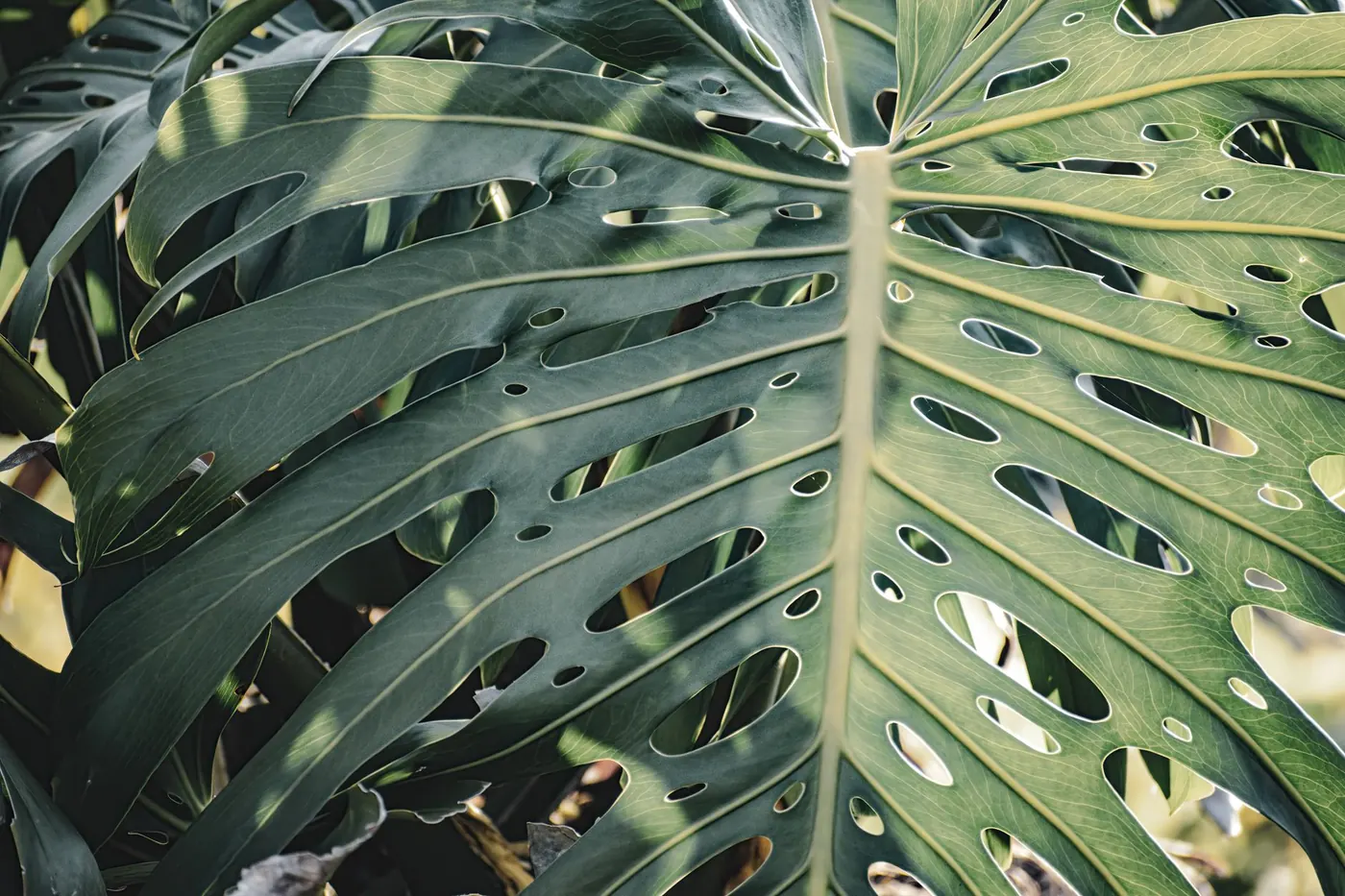
Botanical overview & native habitat
Monstera is a genus of around 50 hemiepiphytic aroids ranging from southern Mexico through Central America to Bolivia and northern Brazil. Seedlings germinate on the forest floor and grow towards the darkest point nearby, usually the base of a host tree. Once they touch bark they climb, anchoring with clasping aerial roots and producing larger, perforated adult leaves as they gain height and light. Many species later lose their connection to the ground and live as epiphytes fed by long feeder roots.
That habit explains indoor culture: roots adapted to bark and leaf litter that dry and re-wet quickly, a vertical support to trigger adult leaves, and bright dappled light rather than direct midday sun.
In UK homes the limit is winter light, not humidity. A south- or west-facing room 1–2m from the glass delivers 150–400 µmol/m²/s from April to September, but between November and February the daily light integral can fall below 3 mol/m²/day and growth stalls. Water less as light falls rather than on a fixed calendar, and accept that a Monstera deliciosa 'Thai Constellation' may push only one leaf over winter.
Variegated forms need more light than green ones because white tissue carries no chlorophyll. 'Albo Variegata' (often sold as Borsigiana Albo) is a chimera and unstable: a stem producing all-green leaves should be cut back to the last well-variegated node, and an all-white leaf cannot feed itself. 'Thai Constellation' is a stable tissue-culture mutation and does not revert.
Our plants grow on in Monstera & Philodendron Chunky Aroid Mix in clear slotted pots. Step up 2–3cm at a time and add a sphagnum moss pole from about 60cm; aerial roots reaching into damp moss are what drive fenestrated leaves indoors.
Propagate from stem cuttings with at least one node and ideally an aerial root; a leaf without a node will root but never grow. Root cuttings in damp sphagnum or water at 20–25°C and pot them into aroid mix once roots reach 5cm. Feed with a balanced liquid fertiliser at half strength every second watering from March to September and stop in winter, when low light means the plant cannot use it. Wipe leaves monthly: UK homes are dusty, and a dusty leaf receives noticeably less light.
Varieties we grow and acclimatise
| Variety | Notes | From |
|---|---|---|
| Monstera deliciosa | The Swiss cheese plant. Splits appear from roughly the seventh or eighth leaf given a pole and good light. | £6.99 |
| Monstera deliciosa 'Thai Constellation' | Stable cream speckling from tissue culture. Will not revert; grows about a third slower than the green form. | £12.99 |
| Monstera deliciosa 'Albo Variegata' | Bold white sectoring on a chimera. Needs 250 µmol/m²/s or more and pruning when it reverts. | £45.00 |
| Monstera adansonii | Fast, heavily holed climber. The best first Monstera for a 9cm to 15cm pot and a short pole. | £4.99 |
| Monstera 'Burle Marx Flame' | Deeply lobed, flame-shaped adult leaves. Juveniles look plain; lobing arrives only once it climbs. | £18.00 |
| Monstera 'Esqueleto' | Skeletal fenestrations on long leaves from the epipremnoides group. Happiest above 65% humidity. | £29.99 |
| Monstera sp. 'Peru' | Thick, puckered, glossy leaves on a compact climber. Often sold as obliqua Peru; true obliqua is far rarer. | £7.99 |
Growth stages & pricing
| Stage | Price range |
|---|---|
| In-vitro tissue culture cup | £12.99 – £34.99 |
| 6cm baby plant | £4.99 – £18.00 |
| 12cm established plant | £18.00 – £45.00 |
| 15cm+ collector specimen | £60.00 – £195.00 |
Substrate & pot
We pot every Monstera in our Monstera & Philodendron Chunky Aroid Mix (AFP 38%). Clear slotted nursery pot, step up 2–3cm at a time; moss pole from 60cm.
- Orchiata Pine Bark 12–18mmStructural air pockets between particles; lignin-rich, so it holds its shape for 18–24 months30%
- Coco Husk Chips 8–12mmHolds water inside each chip while leaving air channels between them20%
- Coarse Perlite 3–6mmPermanent lightweight air space that never decomposes15%
- Volcanic Pumice 4–8mmMineral skeleton with internal pores; adds weight to stabilise plants on moss poles15%
- Horticultural Charcoal 5–10mmStable macropores and adsorption of some organic breakdown compounds10%
- Organic Worm Castings <2mmSlow-release nitrogen, microbial life and cation exchange capacity10%
Troubleshooting
| Symptom | Likely cause | What to do |
|---|---|---|
| Lower leaf yellowing while the mix is still damp | Root zone staying wet for over 10 days in low winter light | Check roots through the clear pot, cut out brown mushy roots and repot into fresh chunky aroid mix; water only when the top 5cm is dry. |
| New leaves small and unsplit | Too little light and no climbing support | Move within 1–2m of a bright window and fit a moss pole; keep the moss damp so aerial roots attach. |
| Brown, crispy leaf margins | Radiator heat or salt build-up from hard tap water | Move away from heat sources and flush the pot with rainwater once a month. |
| White sections on variegated leaves turning brown | Chlorophyll-free tissue drying first in low humidity or after a dry spell | Keep humidity above 60% and water evenly; trim dead tissue with clean scissors, leaving the green. |
| Albo stem producing all-green leaves | Chimeral reversion | Cut back to the last node with good variegation; the next bud usually carries it. |
| Silvery stippling and black specks under leaves | Thrips feeding | Shower the foliage, then release Amblyseius swirskii; repeat in three weeks if young thrips persist. |