What is in the bag
- Buffered Coco Coir <3mm screenedSteady moisture film; calcium-buffered and rinsed to a low starting EC35%
- Fine Orchiata Pine Bark 4–8mmAir pockets at a scale fine roots can use; slows coir compaction20%
- Vermiculite 2–4mmWater held between its plates; high CEC buffers feed15%
- Coarse Perlite 3–6mmKeeps the fine fraction open and aerated15%
- Organic Worm Castings <2mmGentle nutrition and an active microbial population10%
- Horticultural Charcoal 3–6mmSmall rigid pores that resist compaction5%
| Physical metric | Value | What it means |
|---|---|---|
| Air-filled porosity | 22% | Share of the pot volume holding air after a full watering has drained |
| Water-holding capacity | 58% | Share of the pot volume holding water at container capacity |
| pH range | 5.8–6.5 | Measured in a 1:1.5 water extract after blending |
| Particle grading | 0.5–8mm | Screened range of the structural fraction |
| Starting EC | 0.2–0.5 mS/cm | Low enough for tissue-culture and freshly cleaned roots |
Who it is for: root morphology
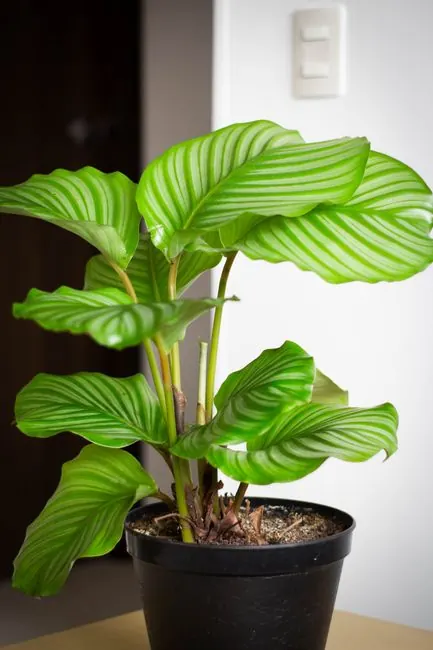
Calatheas (most now reclassified as Goeppertia), Maranta, Stromanthe and Ctenanthe are terrestrial understorey plants of tropical American rainforest. They grow from short, branching rhizomes with dense, fine fibrous roots that spread through the top few centimetres of leaf mould. Many of those roots carry small white storage tubers, a few millimetres across, which hold water and starch against short dry spells. Seeing them when you repot is a sign of a healthy plant, not a pest.
These roots are thin, have little capacity to store water themselves, and sit in soil that in the wild is almost never dry. They are also highly sensitive to dissolved salts: fluoride, sodium and accumulated fertiliser all show up as brown, crispy leaf margins long before the roots look damaged. Ferns such as Nephrolepis and Adiantum have a similar fine, shallow root system and respond to the same conditions.
Plants this blend suits: Goeppertia orbifolia (Calathea orbifolia), Goeppertia makoyana, Goeppertia lancifolia, Goeppertia 'White Fusion', Goeppertia warszewiczii, Calathea 'Medallion', Calathea zebrina, Maranta leuconeura 'Fascinator', Maranta leuconeura 'Kerchoveana', Stromanthe sanguinea 'Triostar', Ctenanthe burle-marxii, Nephrolepis exaltata, Adiantum raddianum, Asplenium nidus, Begonia rex.
Why this formulation works
This is the only blend in our range where we deliberately accept a lower AFP, 22%, in exchange for a WHC of 58%. Calatheas and Marantas need the substrate around their fine roots to stay evenly moist; let it dry completely and leaf edges crisp within days, a problem made worse by the 30–40% relative humidity of a centrally heated British living room. But 22% air is still roughly three times what a slumped multipurpose compost holds, and it is enough to keep the fine roots respiring and the rhizome sound. The difference between a moist mix and a waterlogged one is air, and this blend keeps both.
The moisture comes mainly from buffered coco coir and vermiculite. We specify coir that has been calcium-buffered and thoroughly rinsed because raw coir can carry enough potassium and sodium to reach an EC above 1.5 mS/cm, far too salty for a Calathea, and because unbuffered coir binds calcium and magnesium from your feed and creates deficiencies. Our coir enters the mix below 0.5 mS/cm, and the finished blend starts at just 0.2–0.5 mS/cm, the lowest of any mix we make. Vermiculite holds water between its expanded plates and has a high CEC, so it smooths out the peaks in nutrient concentration after each feed, another protection for salt-sensitive roots.
Coir on its own would compact into a dense, airless block within a year, so fine 4–8mm bark, perlite and a little charcoal form a lattice that holds it open. The particle size range of 0.5–8mm is narrow on purpose: very coarse pieces would leave dry pockets that fine roots cannot cross, while dust-fine particles would fill the air spaces. Worm castings at 10% feed the plant gently and maintain an active microbial population, which helps keep the root zone resistant to the opportunistic fungi that move in when roots are stressed.
Water quality matters as much as the mix. In the hard-water regions of southern and eastern England, tap water at 250–320 mg/L CaCO₃ carries bicarbonate that raises pH and leaves mineral deposits, and many supplies also contain fluoride, to which Calatheas are notably sensitive. Rainwater, filtered water or water from a reverse-osmosis unit, fed at a quarter strength, keeps EC low and leaf edges clean. Because the surface of this mix stays moist, it is more attractive to fungus gnats than our open blends; a 1cm top dressing of coarse perlite or grit and a dose of Steinernema feltiae nematodes keep them in check without drying out the roots.
When and how to repot
- Repot in spring or early summer, when new leaves are emerging, roughly every 12–18 months. Calatheas and Marantas resent disturbance in winter.
- Moisten the mix thoroughly the day before. A coir-based blend that goes into the pot dry absorbs water unevenly and can leave dry pockets around the roots.
- Water the plant a few hours before repotting so the rhizome and storage tubers are fully hydrated.
- Ease the plant out and loosen the outer roots gently. Keep the white storage tubers intact; they are part of the root system. Remove only roots that are brown, mushy or hollow.
- If the plant has several rhizome sections, this is a good moment to divide it, cutting through the rhizome with a clean knife so each piece has leaves and roots.
- Choose a pot just 2–3cm wider than the root ball. Set the plant at the same depth and fill around it, firming lightly with your fingertips to remove large air gaps without compressing the mix.
- Water with soft or filtered water until it drains, and keep the plant out of direct sun and away from radiators while it settles. Resume quarter-strength feeding after four weeks.
Open the repotting calculator pre-set for Calathea & Maranta Mix to work out litres, bag sizes and pot sizes for your whole collection.