Climate, light & humidity
Manchester's rainy reputation reflects its position on the western side of the Pennines, where Atlantic weather drops its moisture. Outdoors the air is often humid, but that does not carry indoors: once the heating is on, North West homes fall to the same 30–40% humidity as anywhere else. The bigger constraint is light. Persistent cloud means winter light is low even by UK standards, and between November and March a typical windowsill receives well under 3 mol/m²/day. Growers who keep Anthurium, Monstera and variegated aroids growing through winter here almost always use supplementary light. Summers are cooler than in the South East, so scorch is rarely a problem, and east and south windows are prime positions.
Watering on soft water
Soft upland water is the North West's great advantage. At under 50 mg/L CaCO₃ it carries little calcium bicarbonate, so it does not push substrate pH up, does not leave limescale spots on velvet Anthurium leaves and suits Calathea, Maranta and ferns straight from the tap. Leave it to stand overnight if you want chlorine to dissipate and to bring it to room temperature.
The flip side is that soft water supplies very little calcium and magnesium. In a substrate with good cation exchange capacity, such as our coir- and castings-based mixes, the feed covers it. In mineral semi-hydro or LECA, where nothing is held in reserve, choose a complete nutrient with calcium and magnesium or add a calcium-magnesium supplement, or new leaves may come out pale or distorted. Rainwater is easy to collect here and works just as well.
Homes & growing conditions
Rows of red-brick Victorian terraces dominate much of Greater Manchester and Merseyside: modest windows, often north or south facing by street orientation, with radiators under the sills. Converted cotton mills and warehouses in Ancoats, Castlefield and the Northern Quarter have large industrial windows that flood deep rooms with light, though cast-iron frames and high ceilings make them draughty and hard to keep warm. Liverpool's Georgian terraces offer tall windows and high rooms. City-centre and Salford Quays towers have big glazing and dry, ventilated air. In older terraces, place plants on a shelf to the side of the window rather than on the sill above the radiator. Check light by room with the light finder.
Trade supply for local stockists
Independent plant shops, florists and garden centres across Greater Manchester, Merseyside, Lancashire and Cheshire stock our retail-ready, barcoded 2.5L and 5L pouches and 25L repotting-bar sacks. Opening orders start at £150 ex-VAT with £100 reorders, carriage is paid over £250 ex-VAT and the stockist margin is 45–50% at recommended retail. From York, trade parcels cross the Pennines in a day. Soft water means North West customers suffer fewer Calathea complaints, but root rot from dense compost is as common here as anywhere, and a shelf of genus-labelled mixes answers that question for your staff. Plan a range with the trade margin planner and see trade terms.
Office & hospitality planting
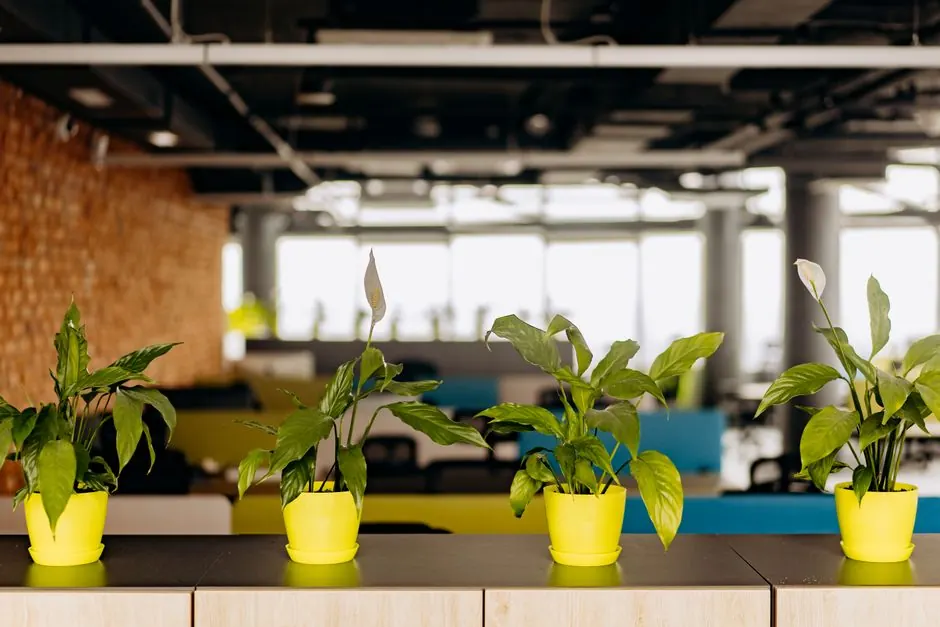
Manchester's creative and tech workspaces, from the Northern Quarter and Ancoats to Spinningfields and Salford, increasingly specify plants as part of the fit-out. Converted mill offices have the light for larger specimens near windows; deeper floor plates need low-light genera such as Aglaonema and Epipremnum. Our schemes are priced from £5.50 a month per desk plant, £15 per medium display and £22 per architectural specimen, with maintenance contracts from £125 a month including fortnightly technician visits, substrate care, biological pest control and free replacement. Start with the scheme estimator and ask about technician coverage via commercial planting.