Climate, light & humidity
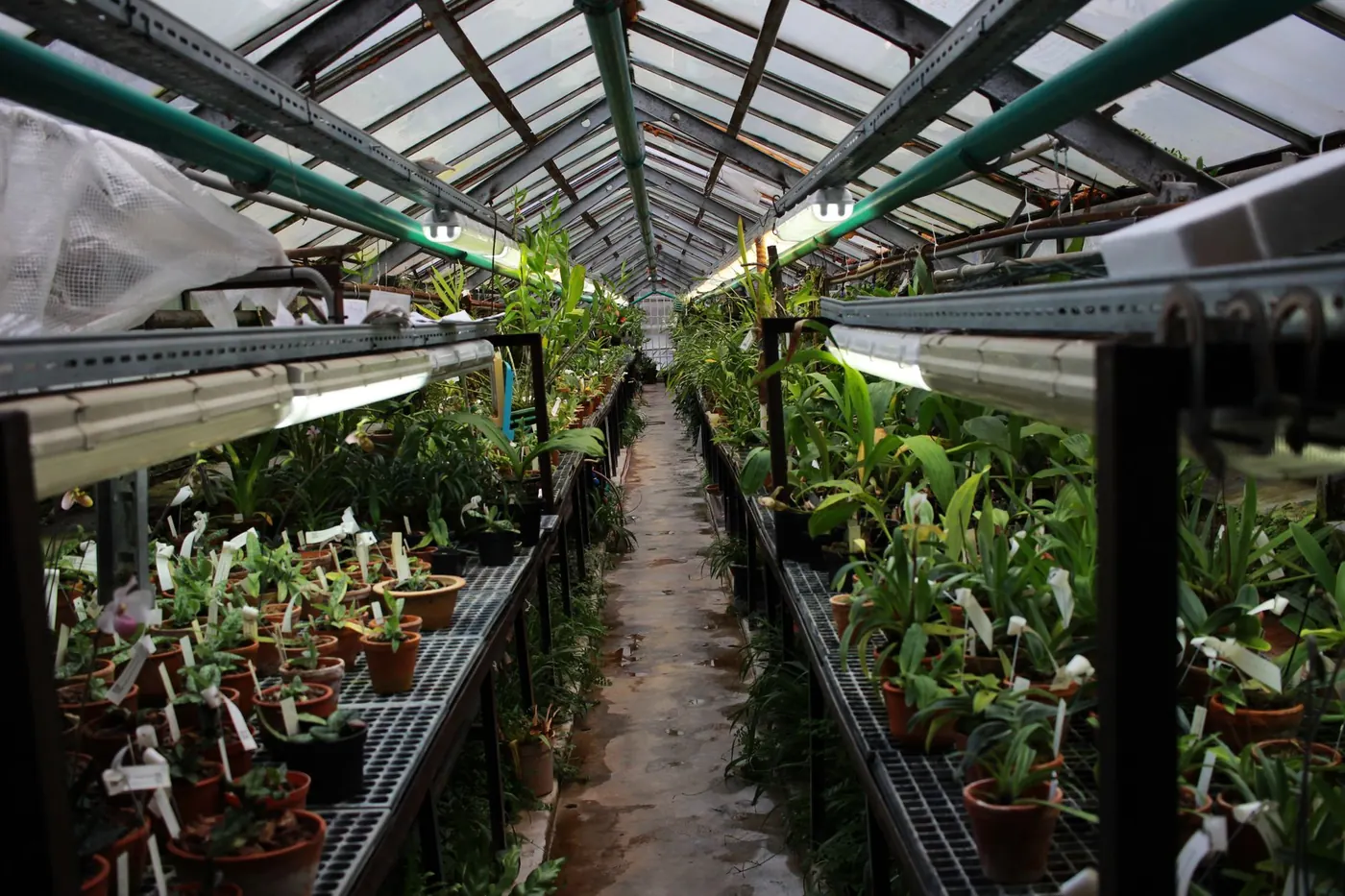
Yorkshire covers a wide range of growing conditions. The Pennine towns of West and South Yorkshire are wetter and cloudier; the Vale of York and the East Riding sit in the rain shadow, drier and sunnier but prone to sharp frosts and winter fog. Winters inland are colder than in the South, and between November and March daily light at a window falls below 3 mol/m²/day, with York getting around seven hours of daylight at the solstice. Our own glasshouses run supplementary lighting through that period for exactly this reason. Indoor humidity falls to 30–40% once heating is on, and stone-built houses with single-glazed sashes can be cold at the window at night. Our winter care guide is written from these conditions.
Watering on soft water
Water hardness varies more within Yorkshire than in almost any other region. Leeds, Bradford, Huddersfield, Halifax and Sheffield receive mostly soft water from moorland reservoirs, which suits Calathea, Maranta and Anthurium straight from the tap. York is moderately hard, and Hull and much of the East Riding draw on chalk aquifers and are hard to very hard. Check your postcode on Yorkshire Water's website before deciding.
In the soft-water areas, the main point is calcium and magnesium for plants in mineral semi-hydro; add a supplement or use a complete hydroponic nutrient. In the harder areas, treat sensitive plants as you would in London: rainwater, filtered water or a half-and-half blend with RO water, and a monthly flush with rainwater to stop salts building up in the substrate. Avoid water from an ion-exchange softener, which adds sodium.
Homes & growing conditions
Yorkshire housing runs from the stone terraces of the Pennine mill towns and Sheffield's hillsides to Leeds back-to-backs, large Victorian semis in Headingley and Roundhay, Georgian townhouses in York and Harrogate, and new-build flats around Leeds Dock and Sheffield city centre. Stone terraces have thick walls and deep window reveals that cut the light reaching a room, so plants do best right at the window, ideally off the sill if a radiator sits below it. Back-to-backs have windows on one side only, so choose plants for that orientation. Victorian bay windows are excellent positions for climbing aroids on moss poles. New-build flats have good light but dry air. The light finder estimates light at each window.
Trade supply for local stockists
We supply independent plant shops, garden centres and florists across Leeds, Sheffield, York, Harrogate, Hull and the rest of the county with barcoded 2.5L and 5L pouches, 25L repotting-bar sacks and shelf talkers. Being close to the nursery means trade orders usually arrive the next working day, which makes smaller, more frequent reorders practical. Terms start at a £150 ex-VAT opening order, with £100 reorders, carriage paid over £250 ex-VAT and a 45–50% stockist margin at recommended retail. Ask the trade team about collection from the nursery. Plan a range with the trade margin planner and read our trade terms.
Office & hospitality planting
Yorkshire is where our commercial planting work is easiest to schedule, because technicians are never far from the nursery. We plan schemes for offices, studios, cafés and hotels across Leeds, York, Harrogate and Sheffield, matching plants to real light levels: tolerant Aglaonema, Epipremnum and Zamioculcas for interior desks, larger specimens near windows. Displays are priced from £5.50 a month per desk plant, £15 per medium display and £22 per architectural specimen, and maintenance contracts start at £125 a month with fortnightly technician visits, peat-free substrate care, biological pest control and free replacement. Use the scheme estimator or contact us through commercial planting.