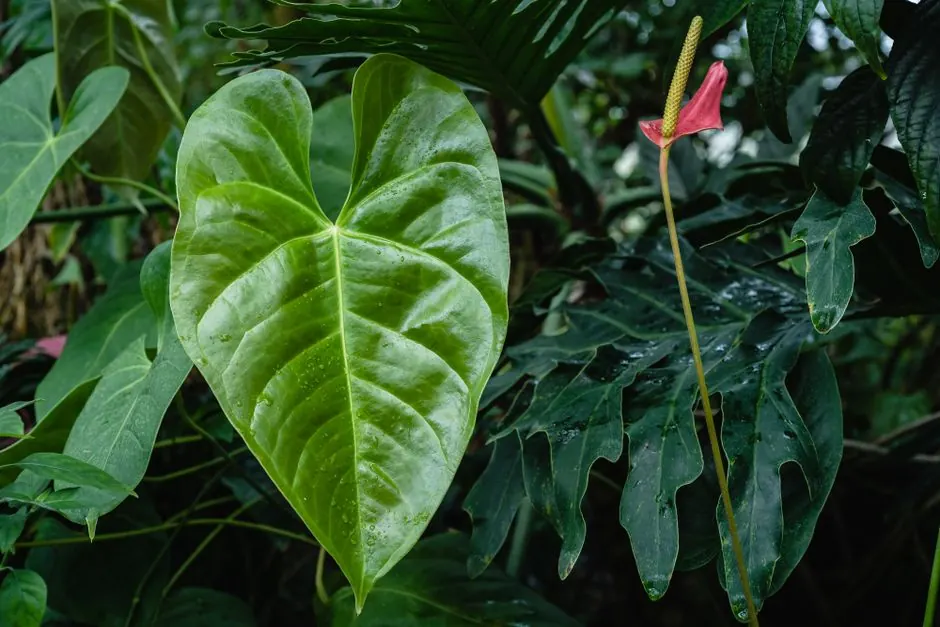
Botanical overview & native habitat
Anthurium is the largest aroid genus, with over 1,000 described species from Mexico and the Caribbean to northern Argentina. The collector species are mostly epiphytes and lithophytes. Anthurium clarinervium grows on limestone outcrops in Chiapas, Mexico; A. crystallinum ranges from Panama to Peru; the Queen Anthurium, A. warocqueanum, and the King, A. veitchii, come from wet Colombian forest, where their long leaves hang from mossy trunks. A. pallidiflorum is an Ecuadorian strap-leaf species with pendant, ribbed leaves.
In the wild their thick, velamen-coated roots wander over moss and bark in near-saturated air, wet daily by mist and drying within hours.
Indoors, the aim is to copy that cycle: roots that are always slightly moist but never sitting in water, and leaves in humid, moving air. Velvet leaves are covered in tiny papillae that scatter light; they mark easily, so place plants where leaves will not rub against glass or each other. New leaves emerge soft and coloured bronze or pink and take two to three weeks to harden.
Clarinervium and crystallinum cope with 60–65% humidity in most homes. Warocqueanum and veitchii want 75–85% and are best in a cabinet or greenhouse with a small fan running; still, saturated air leads to bacterial leaf spot. Hang or raise pendant species so long leaves can drop without touching the bench.
Anthurium roots rot fast in peaty compost, and our plants grow in Anthurium Epiphytic Velvet Mix, built around coarse bark, sphagnum and charcoal. In hard-water areas, use rainwater or filtered water: limescale builds up in the mix and burns leaf margins. Feed at quarter strength every other watering from March to October.
Propagation is slow but simple. Mature plants produce basal offsets with their own roots, which can be divided at repotting in spring; stem sections with two nodes and an aerial root also root in damp sphagnum in a closed box within four to eight weeks. Many collector plants are hybrids, so seed rarely comes true. If you are buying for a cabinet, a tissue culture cup or a 6cm plant is fine; for a living room, a 12cm established plant has thicker, hardened leaves that tolerate drier air far better.
Varieties we grow and acclimatise
| Variety | Notes | From |
|---|---|---|
| Anthurium clarinervium | Thick, heart-shaped velvet leaves with silver veins. The most forgiving velvet for a home. | £11.99 |
| Anthurium crystallinum | Larger, thinner velvet leaves with crystalline veins. Likes 65%+ humidity. | £12.99 |
| Anthurium crystallinum x magnificum | Hybrid with broad, dark velvet leaves and bold veins. Vigorous and tolerant. | £14.99 |
| Anthurium warocqueanum | The Queen Anthurium. Long, narrow velvet leaves; needs a cabinet and steady warmth. | £19.99 |
| Anthurium veitchii | The King Anthurium. Ribbed, glossy pendant leaves that can pass a metre at maturity. | £24.99 |
| Anthurium pallidiflorum | Narrow, ridged strap leaves that hang. Grow it high up or in a basket. | £16.99 |
Growth stages & pricing
| Stage | Price range |
|---|---|
| In-vitro tissue culture cup | £11.99 – £29.99 |
| 6cm baby plant | £9.99 – £18.00 |
| 12cm established plant | £25.00 – £55.00 |
| 15cm+ collector specimen | £65.00 – £195.00 |
Substrate & pot
We pot every Anthurium in our Anthurium Premium Epiphytic Mix (AFP 44%). Clear slotted pot or net basket, kept shallow; raise or hang pendant species.
- Coarse Orchiata Pine Bark 12–18mmPrimary anchoring surface and large air channels35%
- Coco Husk Chips 10–15mmPeat-free, sustainable alternative to tree fern fibre; water stored inside the chip20%
- Coarse Perlite 6–9mmExtra-large air space; prevents bark from bedding down15%
- Volcanic Pumice 6–10mmWicks moisture up through the matrix and adds stability15%
- Long-Fibre Sphagnum Moss Strands 2–5cm strandsHumid micro-pockets around root tips without clogging air spaces10%
- Horticultural Charcoal 5–10mmRigid pores and a slight buffer against souring5%
Troubleshooting
| Symptom | Likely cause | What to do |
|---|---|---|
| Translucent, yellow-haloed spots spreading on leaves | Bacterial leaf spot in still, saturated air | Remove affected leaves, add a small fan and stop misting; keep humidity high but moving. |
| Brown, burnt leaf margins | Salt or limescale build-up from hard tap water or heavy feeding | Flush with rainwater and feed at quarter strength only. |
| New leaf deformed or stuck | Humidity dropping during emergence | Hold 70%+ until the leaf hardens; bag the leaf if needed. |
| Roots blackening at the base of the stem | Compacted or peaty medium | Cut out dead roots and repot into velvet mix in a shallow pot. |
| Scratches and marks on velvet leaves | Leaves rubbing on glass or neighbours | Space plants so leaves hang free; marks are permanent but harmless. |