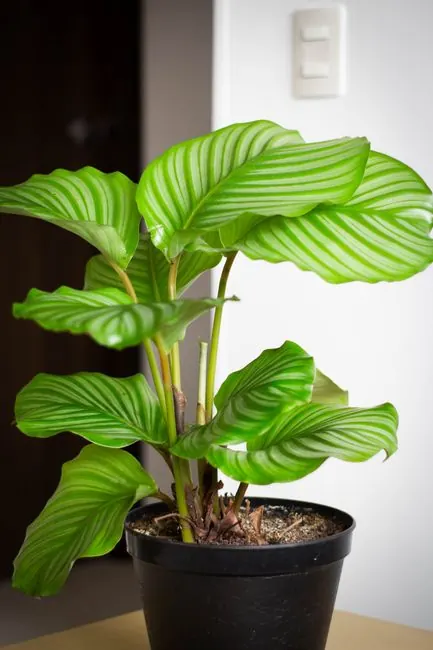
Botanical overview & native habitat
The prayer plant family, Marantaceae, grows in the shaded understorey of tropical forest, mostly in Central and South America. In 2012 most of the patterned plants sold as Calathea were moved into the genus Goeppertia: Goeppertia orbifolia, G. makoyana and G. lancifolia are the old Calathea names. Maranta leuconeura and Stromanthe sanguinea come from the Brazilian Atlantic forest. All grow from rhizomes in damp, humus-rich leaf litter where the soil rarely dries and rainwater carries very little dissolved mineral.
At the base of each leaf blade sits a pulvinus, a swollen joint that raises leaves at night and lowers them by day. This movement gave the family its common name.
Crispy brown edges are the problem everyone asks about, and there are three causes, usually acting together. First, dissolved salts: much of England has water above 200 mg/L CaCO₃, and fluoride, chlorine and limescale accumulate in leaf margins. Water with rainwater, distilled water or filtered water with an electrical conductivity under about 0.3 mS/cm, and flush the pot thoroughly every month. Second, drying out: these plants want evenly moist roots, so never let the pot dry right through. Third, dry air below 50% humidity, especially near a radiator.
Feed at quarter strength every other watering from April to September; full-strength feed raises the EC and burns edges just like hard water. Give them bright shade, 50–150 µmol/m²/s, well away from direct sun, which fades patterns and curls leaves. Curling inward during the day is a sign of thirst or dry air.
We pot Marantaceae in Calathea, Maranta & Fern Mix, which holds water in coir and fine bark while staying open enough to avoid rot. These plants are listed as non-toxic to cats and dogs, which makes them the standard choice for pet homes.
Divide congested plants in late spring by separating rhizome sections that each carry three or more leaves and their own roots; Marantaceae cannot be grown from leaf or stem cuttings. Keep divisions warm and enclosed for two to three weeks while they settle. In winter, hold temperatures above 16°C and keep plants away from cold windows at night, as chilled roots in wet compost are the commonest cause of collapse between November and March.
Varieties we grow and acclimatise
| Variety | Notes | From |
|---|---|---|
| Goeppertia orbifolia | Large, round leaves with silver bands. Sensitive to hard water; the best test of your watering. | £9.99 |
| Goeppertia makoyana | The peacock plant: feathered dark ovals on pale leaves with purple undersides. | £7.99 |
| Goeppertia lancifolia | The rattlesnake plant: long, wavy, spotted leaves. Tougher than most. | £6.99 |
| Goeppertia 'White Fusion' | Streaked white, green and lilac. Needs steady humidity above 60%. | £12.99 |
| Goeppertia warszewiczii | Velvety dark leaves with a fishbone pattern. Larger and slower. | £11.99 |
| Maranta leuconeura 'Fascinator' | Red-veined prayer plant that folds its leaves up at night. Trails or bushes. | £5.99 |
| Stromanthe sanguinea 'Triostar' | Pink, cream and green leaves with magenta undersides. Wants more light than Calathea. | £8.99 |
Growth stages & pricing
| Stage | Price range |
|---|---|
| In-vitro tissue culture cup | £8.99 – £14.99 |
| 6cm baby plant | £4.99 – £12.99 |
| 12cm established plant | £18.00 – £32.00 |
| 15cm+ collector specimen | £60.00 – £85.00 |
Substrate & pot
We pot every Calathea & Maranta in our Calathea, Maranta & Prayer Plant Moisture-Retentive Mix (AFP 22%). Clear slotted pot or glazed cachepot to slow drying; avoid unglazed terracotta.
- Buffered Coco Coir <3mm screenedSteady moisture film; calcium-buffered and rinsed to a low starting EC35%
- Fine Orchiata Pine Bark 4–8mmAir pockets at a scale fine roots can use; slows coir compaction20%
- Vermiculite 2–4mmWater held between its plates; high CEC buffers feed15%
- Coarse Perlite 3–6mmKeeps the fine fraction open and aerated15%
- Organic Worm Castings <2mmGentle nutrition and an active microbial population10%
- Horticultural Charcoal 3–6mmSmall rigid pores that resist compaction5%
Troubleshooting
| Symptom | Likely cause | What to do |
|---|---|---|
| Crispy brown leaf edges | Hard tap water, high-EC feed or the mix drying out | Switch to rainwater or filtered water, flush monthly and keep the mix evenly moist. |
| Leaves curling inward by day | Thirst or very dry air | Water thoroughly and raise humidity above 60%. |
| Patterns fading and leaves bleached | Direct sun | Move to bright shade, 50–150 µmol/m²/s. |
| Fine speckling and webbing on leaf undersides | Spider mites | Shower weekly, raise humidity and release predatory mites. |
| Stems collapsing at the base | Rhizome rot from cold, wet compost in winter | Divide out healthy sections and repot into fresh fern mix; keep above 18°C. |
| Yellow spots between veins on new growth | Nutrient lock-out from limescale raising the pH | Flush with rainwater and repot if the mix is crusted white. |